



Discoverability is one of the toughest problems facing the games industry, particularly if you’re a tiny indie studio with barely any marketing budget. So Sentinel Games is designing with discoverability in mind – baking in some clever Twitch integration tools that it hopes will attract streamers, and hence give their game a handy bit of free promotion.
Doron Nir, the founder and CEO of Sentinel Games, grew up in Israel, and he was a journalist before he moved into game development. “I often think about what would have happened if I stayed on the journalistic side of the video games industry,” he muses. “I loved being a journalist so much. It’s so much fun. It has that touch and go feeling where you can immerse yourself in a product and in a creation process and then just move to the next project next week or the following day.”
By contrast, making games involves long-term commitment to a project. “Game development is about the ability to forget the previous day and start fresh with excitement and with enthusiasm and a critical eye to what you’re building every single day. It’s a little bit like marriage. You have to fall in love with your wife every single day.”
Back in his journalist days, Nir founded the Hebrew-language games website V Games, and in 2016 he met a former V Games employee, Or Perry, who had been working on a suite of cloud tools for live-streaming content creators. Together, they went on to co-found the company StreamElements.
The firm offers things like customizable alerts and chatbot moderation for streamers. “It became very successful,” says Nir. “And while we were building that platform and that business, I started noticing something very, very interesting in video games marketing.”
It’s well-documented that content creators have edged out traditional media as the primary marketing channel over the past decade, and Nir was aware that streamers were often paid to promote premium titles. “However, other games were adopted organically by content creators,” he says. “And then you would see breakout hits that content creators almost virally embrace, and there was no financial or business reason for that. These were not AAA games, these were indie hits. And I started looking at these games and trying to understand what was the quality that was making these games embraced so organically and so excitedly by content creators.”
Nir worked on distilling the essence of the kind of game that would appeal to a content creator. “They are virtually never single player. They are virtually never story driven. They have a narrative, but the narrative is very, very light: It’s almost like an envelope for the chaos that’s poured into it. Most of these games are multiplayer co-op, and they have a very basic premise. And then you can just cause a lot of chaos and mayhem – what we fondly call shits and giggles.”
It’s a template that could easily describe some of the biggest breakout hits of 2025, like RV There Yet? or Peak, and before that, titles like Supermarket Together, which has sold over 11 million copies, according to GameDiscoverCo. “These are insane numbers for video games,” says Nir. “And so the idea of founding Sentinel Games was based essentially on that: We wanted to create games that first and foremost provide a stage for online performance and for the fun that comes with it. And in addition, because we are dealing with content creators, we wanted to do some cool things inside the game that we rarely saw other video game companies do, which is connect the game engine itself to the streaming platform.”
The idea was to connect Unreal Engine directly to the chat function in Twitch, so that viewers can activate things in the game, says Nir. “And that became one of the core principles of this technology that we’re building as part of Sentinel Games, which we call the Shoutout Engine.”
.jpg?width=2048&height=2048&fit=bounds&quality=85&format=jpg&auto=webp)
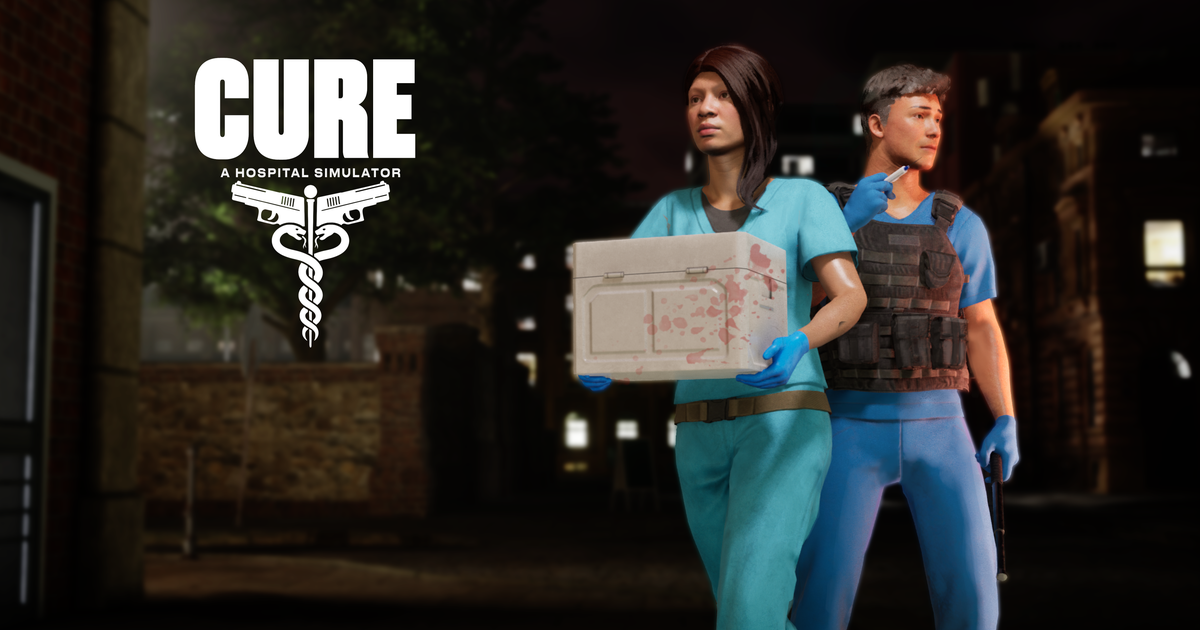
The fruits of this technology are on show in Cure: A Hospital Simulator, which Sentinel launched in Steam Early Access in November. The premise: what would happen if you were running a hospital in the middle of a zombie apocalypse? Up to four players work together to set up an emergency room, diagnosing and treating patients afflicted with various ailments – but if any patients show signs of turning into a zombie, the treatment becomes a bullet to the head. Nir says the game was built with the idea of promoting performance, chaos, and co-op – all elements that would appeal to content creators.
But the selling point of Cure is that Twitch viewers can create NPC patients to send into a streamer’s game – complete with their name and Twitch avatar – from within the Twitch window. “They activate it just with a chat command,” explains Nir, adding that viewers can customize the clothes and appearance of their NPC. In addition, Twitch alerts can be integrated into the streamer’s game environment. “So the ER that you’re running has monitors all over that communicate information around several major events in the game, but they’re also presenting follow alerts and subscriber alerts,” explains Nir.
Nir acknowledges that Cure isn’t the first game to feature some form of Twitch integration. “Interaction between chat and game is something that many companies have done. Cult of the Lamb had that: They had a very successful Twitch extension.” But he thinks the Shoutout Engine is bringing something fresh. “The thing that we are doing, which is relatively new, is instead of just creating new interactions in the game, we’re also bringing Twitch alerts into the game.
“But the more important thing is that when it comes to connecting games to Twitch, it is very important to enable content creators to customize – because not all channels are created equal. Some channels are being broadcast to 10 or 20 audience members, some to 10,000 or 20,000. You need a completely different level of rules and customization. With 20, pretty much anything goes, and you’re just excited that your audience is participating and engaging. With 20,000, you need a lot of gatekeeping on what not to allow and what level of grief you’re willing to suffer when you are playing the game.”
Of course, allowing viewers to mess with a streamer’s game does raise some questions around potential harassment and abuse – and Nir says this is something that is at the forefront of content creators’ minds whenever he presents the technology to them. But Nir is quick to reassure that viewers’ interaction with the game is deliberately limited. “We avoid the ability of anyone pushing chat into the game,” he notes, adding that the NPC only carries the user’s Twitch name, which is “going to be safe because it goes through the entire moderation systems of Twitch, and you can’t put slurs in there.” Furthermore, the viewer can’t control the NPC once it’s unleashed in the game.
Plus, there’s no danger of thousands of viewer-created NPCs being released at once, since bigger channels operate a queuing system for NPC creation. “Safety is the number one consideration for us,” says Nir. “The most important thing is that when a content creator plays our game, everyone will have fun, everyone will promote chaos and excitement, and no one will get hurt, especially not the content creator.”
“When the audience realizes that they can hit a chat command and see themselves in the game, it blows up”
Nir says that for the moment, the Shoutout Engine is limited to Twitch integration, but they’re aiming to integrate Discord later this year, and provide Unity support further down the line. Ultimately, they want to offer it to other developers. “Once the technology is stable and scalable enough, we have plans of opening this to more game developers so that other people might be able to use it,” Nir says. “The goal is that it will become its own thing. It will become a platform.”
The hope is that by attracting streamers with this novel tech, Cure might receive some free promotion that Sentinel Games would otherwise be unable to afford. “Hey, we’re an indie studio,” shrugs Nir. “We have very, very little funds. We don’t have millions of dollars to put into marketing. […] I just hope that creators are going to look at this, and be like, ‘Okay, this is worth the try.’ And I just want to see the data that comes from this to know if the thesis is correct or not.”
It’s still early days, but so far, the plan seems to be working. Nir says Cure has sold over 20,000 copies since entering Early Access in November, with an average play time of 5.5 hours. Most importantly, the game has been streamed on Twitch by over 1,000 creators, for a total of 116,000 watched hours, all with zero marketing budget. “When the audience realizes that they can hit a chat command and see themselves in the game, it blows up, because that is something that they very rarely get to do when they watch their favourite creators.”
