



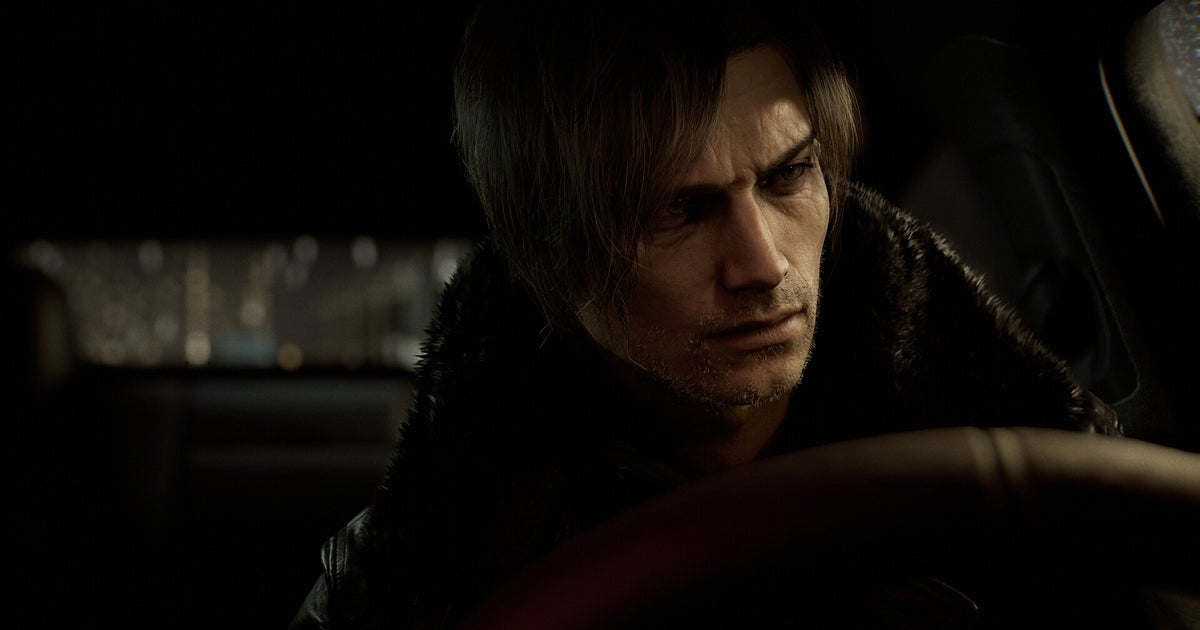
Announced last year at Summer Game Fest, Resident Evil: Requiem has been a major financial boost for Capcom. It’s the ninth mainline game in the Resident Evil series – which celebrates its 30th anniversary this year – and has stirred excitement among longtime fans with the return of Leon S. Kennedy, who makes his first appearance in a mainline title since 2012’s Resident Evil 6.
Requiem alternates between Leon and the new protagonist, Grace Ashcroft – an FBI analyst and daughter of Alyssa Ashcroft from Resident Evil Outbreak.
The survival horror follows Grace as she investigates a string of deaths in an abandoned hotel in the American Midwest, where her mother was murdered eight years ago. Leon is drawn to the hotel after reports of a missing police officer.
Despite being the ninth game in the mainline series, Requiem was “designed to be welcoming to complete newcomers.”
“While series fans will instantly recognise Leon, Grace is a brand-new character who’s never faced a zombie and only knows about the Raccoon City incident through her mother’s involvement,” said game director Koshi Nakanishi. “New players can dive into their first Resident Evil adventure right alongside Grace.”
The PS5 version of the game currently has a “generally favourable” score of 88 on Metacritic, and the consensus is that Capcom has delivered a true “celebration of Resident Evil’s three decades of cultural relevance,” as Nat Smith summed up in her 8 out of 10 review for PCGamesN.
“In fact, the callbacks are so relentless that Requiem can occasionally feel like playing through an overly elaborate pastiche rather than a new mainline entry in the series,” Smith remarked.
“Déjà vu is a constant companion for the devoted fan, conjuring up scattered memories of the most innocuous moments – think attic ladders, broken windows, and mutated arms – all overshadowed by major character reveals.”
Brimming with nostalgia
Smith described Requiem as a “compilation of greatest hits” – a sentiment similar to that held by VGC’s Dave Aubrey. “As its own game, its own entry into the mainline Resident Evil pantheon, it can feel more like a remastered greatest hits album,” Aubrey wrote, rating the title four out of five stars.
“In some ways, it acts as an incredible celebration of everything that Resident Evil is and has been up to this point, just in time for its 30th anniversary. In others, it feels like a retread that doesn’t live up to its inspirations.”
For Aubrey, Grace’s sections felt heavily inspired by Resident Evil 2 as she attempts to escape a facility overrun with zombies. Leon’s return to Raccoon City brought back elements from Resident Evil 4, including resource gathering, upgrading weapons, and collecting key items, “while cracking skulls and parrying literally any attack that comes in Leon’s way.”
“Therein lies the problem,” said Aubrey. “As a thematic arc, Resident Evil: Requiem is brilliant, beautifully using the recent remakes of Resident Evil 2 and 4 to show Leon’s progression from naive rookie to confident agent, and now, practically Captain America.”
Startmenu’s Artemis Octavio also noticed the callbacks to Resident Evil 4, as well as heavy influence from Resident Evil 7. Overall, she felt Requiem “is attempting to be two games at once, trying to reach what I consider to be the two highest points of the series.”
Leon’s sections embody the “frenetic, over-the-shoulder gun-action gameplay of Resident Evil 4,” while those featuring Grace are akin to the “slow-walking, dread-filled, first-person gameplay of Resident Evil 7.”
In a five stars out of five review, Restart’s Myles Obenza noticed even deeper callbacks to “more obscure Resident Evil titles.”
“[Reqiuem] answers some lingering questions (while presenting just as many new ones), and includes plenty of fan service to make the old heads like me appreciate Capcom’s willingness to revisit plot points long thought abandoned.”
The return of Leon
Speaking of nostalgia, Leon’s appearance in Requiem was met with adoration among reviewers, especially for how the federal agent has aged like fine wine.
Game director Koshi Nakanishi previously said the team “spent quite a lot of time polishing Leon’s visuals,” with “women in particular [being] pretty strict when reviewing his design.”
“Throughout the development process, Leon was thoroughly refined, and I think we managed to come through with a design that would make anyone’s heart throb,” said Nakanishi.

They certainly did, as Aubrey discovered. “Leon is daddy. He used to be babygirl, and now he’s daddy. It’s quite incredible, really, the character designers have managed to make a Leon so suave and charming that he even made me swoon in my seat and fan my face.”
PCGamesN’s Smith liked how Leon has aged alongside the game’s players. “When I first met Leon, I was a wide-eyed six-year-old, and he was a ’90s heartthrob. Now, I’m in my thirties, we’ve both got dark circles around our eyes, and somehow curtain bangs are back in style.”
Octavio at Startmenu appreciated how Capcom made a man who “has survived god knows how many biochemical outbreaks […] look as debonair as ever,” but criticised the overarching nostalgia.
“My biggest grievance is when he retreads the same grounds, re-encounters a sworn enemy from his past, for no apparent reason other than for the sake of nostalgia. Even his one-liners have lost some potency; he sounds exhausted and ready to retire.”
Mid-2000s Raccoon City
Octavio also didn’t appreciate how Leon is “unfortunately relegated to the game’s worst sections” in terms of environmental setting.
“The environment he’s primarily placed in was rather drab, a lot of dull greys and washed-out browns. It’s a noticeable shift, as his opening section is a bustling street full of ray-traced street lights and heavy rain, a technical showcase, and the hospital’s pitch-black corners fill you with dread for the opening hours.”
Smith agreed. While she said it was “hard to overstate the emotional weight of bringing Leon back to where it all began” in Raccoon City, it was a shame that Capcom “inexplicably decided to resurrect the brown filter of the mid-2000s right along with it.”

“Yes, Raccoon City is a bombed-out husk in Requiem, but it’s so nondescript that it could really be any post-apocalyptic city in any third-person shooter released in the last two decades.”
However, for Restart’s Obenza, it’s here that the game’s combat truly shines, particularly now that zombies can carry weapons in Requiem. “And you know what’s worse than zombies with a machete? Zombies with guns.” He thinks this adds some helpful variation. “The inclusion of traditional zombies in Requiem compared to the fast-moving Ganado or Majini from previous games had me a bit sceptical at first, but the amount of variety in the way they’ll attack and the weapons they can wield offers a more fresh and engaging experience than I was expecting.”
A fresh take
Requiem’s gameplay follows the Resident Evil formula, as PCGamesN’s Smith noted, where “the exploration is freeform, yet dovetails beautifully along a linear path […] It’s even more fun to see this series convention from the perspective of a terrified new protagonist.”
For Smith, the introduction of Grace represents a “soft reset” for the franchise, letting new players experience the world established in 1996 with the original Resident Evil.
“Through Grace, Capcom strips all of that away to get back to basics: the living versus the dead. Her sections evoke the early hours spent in the Baker house in Resident Evil 7, a silent acknowledgement of its role as a soft reboot that lifted the series from the doldrums of Resident Evil 6.”

And it’s with Grace where “the horror is amped up to 11,” as Restart’s Obenza commented. Players can switch between first- and third-person perspectives in Requiem, with Capcom recommending Grace in first and Leon in third.
“The first-person perspective truly drives home the immersive and tense atmosphere the developers were trying to achieve,” said Obenza. “You can’t peek around corners as easily in first person, and coming face-to-face with a zombie at arm’s length in a tight, dark corridor will scare the pants off just about anyone.”
Obenza highlights a particular moment in a basement where Grace is confronted by a “hulking, monstrous creature”. The game teaches you that not engaging and creeping around enemies is the way to survive, but in this moment, “you have no choice but to come within a stone’s throw of the [monster], manoeuvring through tight spaces to dodge her grasp and collect the batteries needed to flip the switch and escape.”
“It’s a clever way of not just forcing you to betray what you became comfortable with doing in the hours prior, but showcasing the devs’ aptitude for creating a truly horrifying and immersive gameplay experience,” Obenza explained. “Even in my New Game+ playthrough, I dreaded having to replay this section – a testament to the fact that, even for a survival horror veteran, good level structure and tight sound design will make or break an experience.”
Dual protagonists
The ability to switch between Grace and Leon in Requiem was a standout for most reviewers. However, VGC’s Dave Aubrey felt that the “two distinct gameplay styles and protagonists [could] sometimes feel at odds with one another.”
“The titular weapon, the Requiem, is the perfect example of that. Grace’s exploration of the Care Centre is Requiem’s highlight, and it’s easily when your nerves will be most fraught, but she gets gifted Leon’s Requiem immediately, which essentially acts as a magnum that can simply remove the most annoying foes from your sight.”
Aubrey continued: “As long as you don’t spend your ammo aimlessly, the Requiem acts as a ‘get out of jail free’ card, giving you an exit from any situation you dislike instantly. Having it in Grace’s inventory for the whole Care Centre might be too much of a comfort in a section that’s supposed to feel intense, having you struggle to survive amongst the horrors.”

Startmenu’s Octavio also found the switch between Leon and Grace to be “jarring” at times. “One moment, you are clinging to the light of a lighter’s flame, stumbling through darkened corridors in the search for ammo, keys, healing items, crafting supplies; solving puzzles; carefully aiming at the head of a shambling infected; soiling your pants when a grotesquerie of flesh and blood chases you down. Then the channel changes – it’s the Leon Kennedy Show now, and he’s doing quips! He just crushed a zombie’s head with a powerful kick! He’s weaving, dodging, and shooting at an army of enemies that would’ve easily overwhelmed Grace.”
But for PCGamesN’s Smith, it was this dichotomy that enhanced her experience. “The cycle of tension and release, so integral to the horror genre, is magnified to encompass Requiem’s entire structure through its dual protagonists,” she wrote. “Grace’s sections are the tension; Leon’s, the release. Leon is, well, Leon, with just a dash of Chris Redfield for grizzled flavour.”
Octavio does point out that “sudden tonal shifts are nothing new to the series,” but that Requiem “achieves with its tone what other games in the series already accomplished: it codifies these sudden shifts with an overwhelming sense of silliness and melodrama.”
Overall consensus
Requiem is a lot of things: a game for longtime fans and newcomers looking to experience survival horror for the first time.
While it didn’t tread new ground for VGC’s Aubrey, Requiem felt like a “fantastic addition to the series” as a whole – “if one is slightly hampered by its inspirations.”
“For a numbered instalment, it’s a bit too safe, in a series where so many of the mainline games have broken the mould and set the standard for both the survival horror genre and over-the-shoulder shooter format.”
“It feels brutally unfair to compare a new game to two that are considered to be genre-defining masterpieces, but those are the comparisons that Resident Evil: Requiem draws. Capcom has once again delivered a polished and brilliant Resident Evil game, even if it’s not quite amongst the very best.”
“It combines the best parts of virtually every modern Resident Evil title”
However, it was these comparisons that made Requiem one of the best games in the series for Restart’s Obenza. “As a culmination of every game that came before, I can confidently say that the story serves as both a fitting conclusion for many threads left open over the years and a benchmark for where we can expect to go from here. It combines the best parts of virtually every modern Resident Evil title, offering the iconic horror atmosphere that pioneered a genre, incredibly satisfying combat mechanics, and immersive puzzle design that even newcomers can enjoy.”
And while Startmenu’s Octavio felt that Requiem “does not reach the prestige of the best in the series, nor is it horrible enough to the point of being interesting,” they aren’t playing it for the narrative.
“I am playing it for that immaculate gun-feel, that craftsman’s sense for detail, that tension that is ceremoniously ruined by the most ridiculous event that you could ever imagine. And Requiem checked all those boxes off, with glee, leaving me feeling mostly satisfied.”
“Even with its disparities, abysmal pacing, and continuations of mechanics already explored and somewhat exhausted, Requiem was a bloody good time, and I look forward to seeing how it digests in my stomach.”
