



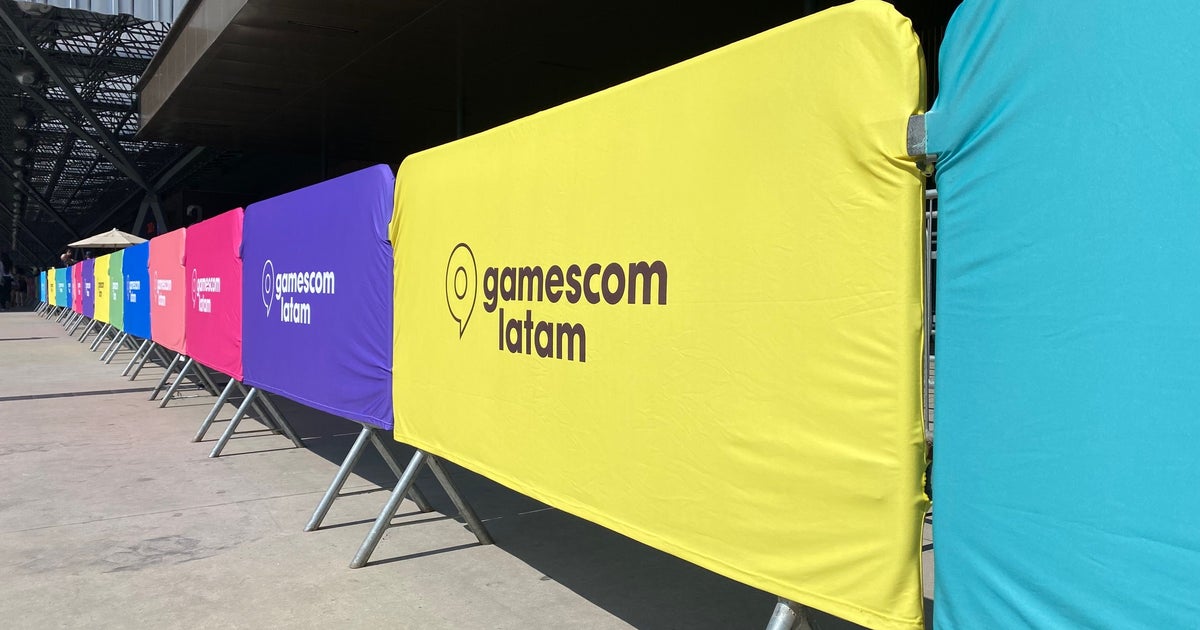
Eliana Russi, head of B2B at Gamescom Latam, gives an emphatic answer when I ask what Brazil’s game development scene needs to take it to the next level. “Money!” she cries, hands in the air.
Everything else is in place. Brazil has a well-established games industry trade body in the form of Abragames, which Russi headed before joining Gamescom Latam. A couple of years ago, the government established a legal framework for video games that redefined the medium in the eyes of the law and opened up opportunities for investment. And since 2024, Brazil has had a world-class trade and consumer event in the form of Gamescom Latam in São Paulo.
Walking around the show floor this week, it’s an impressive showcase for Brazilian developers and Latin American countries more generally, as well as a great indicator of Brazil’s intent to foreground the region as an appealing destination for investment and business. Many of the biggest names are here with flashy booths, including Nintendo, Nvidia, AMD, Riot Games, and Roblox – although the absence of stands for PlayStation and Xbox was notable.
Still, representatives from Sony and Microsoft can be found flitting around in the B2B area, and the latter has a dedicated ID@Xbox meeting cubbyhole. Plus there is no shortage of representatives from foreign companies scouting for games, including the likes of Evil Empire and Focus Entertainment.
Gamescom Latam is much, much smaller than its Cologne cousin, although still enormous – and growing year by year. Consumer attendance on Thursday was healthy, although the really big crowds are expected over the weekend. Last year the event attracted 130,000 visitors, up 30% on 2024.
The Brazilian games industry has a long history of external development. The largest co-dev studio in the country is Kokku, which was founded in 2011, and has worked on the likes of WRC, Call of Duty Black Ops: Cold War, and the Burning Shores DLC for Horizon: Forbidden West. But in a panel on external development featuring Stephanie Arnett from Epic Games, Julian Castano from Sony, and David Lam from Blizzard, the consensus was that although Brazil is highly promising, it’s still in the up-and-coming phase.
.jpeg?width=2048&height=2048&fit=bounds&quality=85&format=jpg&auto=webp)
Arnett said Brazil is “not quite there yet for AAA, but it’s on the way,” while Castano described the region as “bubbling.” In short, it’s a place to invest in for the future: as Lam said, “We’re looking at the long term.”
In terms of the Brazilian indie scene, there was no shortage of talent on display at Gamescom Latam. Perhaps we’re nearing the boil. Highlights included Talaka by Potato Kid (which is being published by Acclaim), Ghostless by Coffeenauts, and Rogue Reigns from Venn Studios, as well as Adventure of Samsara from Ilex Games, which had the misfortune of launching on the same day as Hollow Knight: Silksong last year.
One particularly impressive game that I was shown, but didn’t have a chance to play, was Black Sailors from Mandinga Games, which sees a group of enslaved people overthrowing their captors and taking to the high seas, resembling a cross between Arco and Sid Meier’s Pirates. The game’s creator, Tiago de Melo Prudente, is from the Bahia region of Brazil, and he says a government grant that was equivalent to around $8,000 was vital to him deciding to pursue making video games full time. “I would never have quit my job unless I got this grant,” he told me. Later, he was able to secure $80,000 in investment from ID@Xbox.
.jpeg?width=2048&height=2048&fit=bounds&quality=85&format=jpg&auto=webp)
His story is indicative of what Brazil needs to take its games industry to the next level: government help. There are some existing grant programs, but little in the way of tax incentives for game makers in the country. That kind of government support is the final piece of the puzzle, the spark that could turbocharge Brazil’s games industry.
Russi thinks that tax incentives and rebates at the state and federal levels could be key to attracting outside investors. As Brian Baglow said in a recent feature on Pocket Gamer, government support has moved from being a “nice-to-have” benefit to being a priority. It can be a clincher when it comes to deciding where to invest.
For Russi, that outside investment is essential to the Brazilian games industry’s future. “Show me the money,” she says. “All we need is money. We have everything: a strong association, public policy is already in a framework, we have a strong event where you can market your game or you can meet. We generate for the local industry $150 million in contracts in three days. It’s not a lot for Silicon Valley or for London, but it’s a lot for us. And so show me the money. We have everything. I guarantee.”
