



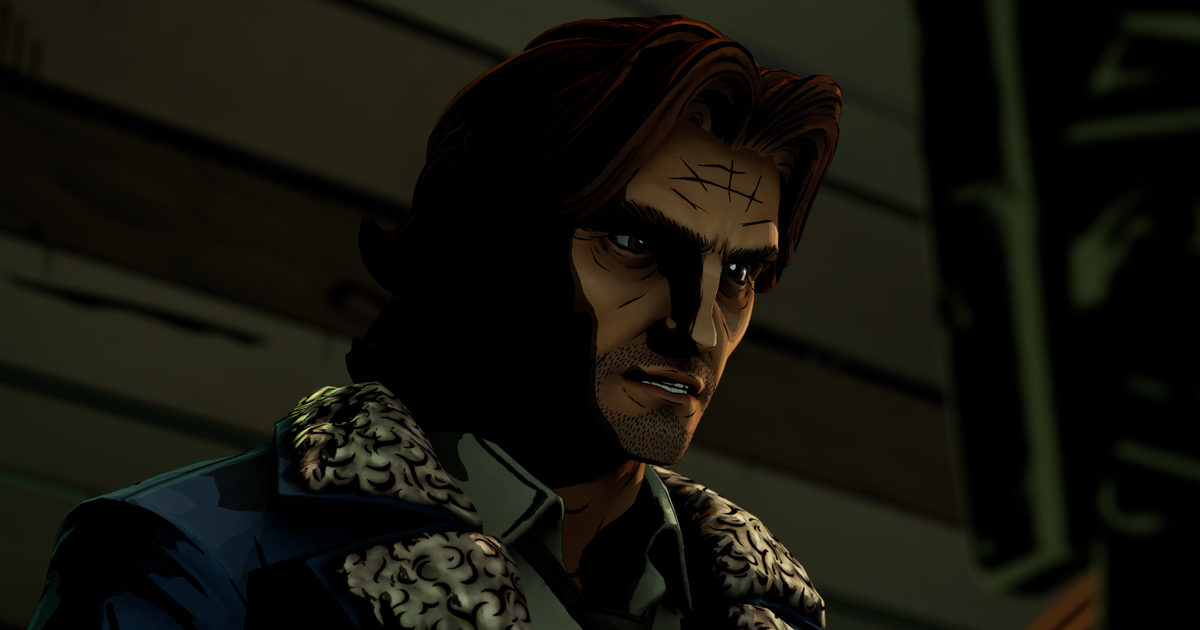
After a long, long wait, the Big Bad Wolf has finally returned.
A trailer for The Wolf Among Us 2 was shown at Summer Game Fest on Friday, nearly a decade after Telltale confirmed that the 2013 original would receive a follow-up. Since then, Telltale has dramatically collapsed and been resurrected, with a promised Wolf Among Us sequel set to launch in 2023, only to be delayed months before Telltale initiated sweeping layoffs. But the project kept on going.
The game underwent a “technical reset” after the company’s initial attempts to use the Telltale Tool tech alongside Unreal Engine 4 proved unworkable, says Telltale CEO Jamie Ottilie. He partly blames this on the pandemic.
“It sounded great on paper and looked like it would provide all sorts of production efficiencies and optimisations, but the hard reality is that wasn’t true,” Ottilie tells GamesIndustry.biz. “It probably took us a little longer to figure that out, as we were learning to function during COVID. Some of the organic communication that happens when teams are located in the same building wasn’t happening. It was a painful moment in time for us in terms of where we were headed.”
As a result, the company moved to using Unreal Engine 5 – but this proved to be a massive setback for production.
“We walked away from years of work that wasn’t going where we wanted it to go,” says Ottilie. “But we didn’t rush and try to keep a release date, we did it and stepped back and reset, and have done a better job this time around. We have acknowledged the mistakes, changed the way we approached the content and are building it. That speaks to the path, how difficult it is to walk the intentional path, and to be mindful of where you are headed and where you are going.”
Alongside the sequel trailer, a remaster of the original The Wolf Among Us was announced at Summer Game Fest, with a Holiday 2026 release window. But there’s no firm release date for The Wolf Among Us 2, aside from a vague “2027”, with Ottilie saying that Telltale won’t be committed to releasing it “until we’re happy”. But the chief exec believes that when the game is finally out, it will be the moment that it’s safe to say Telltale Games is back.

“We’ve been on that journey since 2019,” he says. “This has been what we’ve been chasing to define what Telltale is going forward. This is really the cornerstone for who and what we are going to be going forward – that should rightfully be the pinnacle of narrative entertainment. That’s what we are after. At the end of the day, our audience is going to tell us whether or not we hit that bar.”
A difficult journey
Telltale Games has been through some dramatic ups and downs over the past two and a bit decades.
Founded in 2004, the company had an absolutely stellar run that started in 2012 with its episodic series based on The Walking Dead comics. That took the studio to the stratosphere. The firm launched The Wolf Among Us, based on DC Comics’ Fables, in 2013. From there, it significantly expanded its output.
In the coming years, Telltale worked on major IPs such as Game of Thrones, Borderlands, Minecraft, Batman, and Guardians of the Galaxy, as well as several more seasons – and a spin-off – of The Walking Dead. A second season of The Wolf Among Us was teased at San Diego Comic-Con in 2017.
But the whole show abruptly came to a close in 2018 when a financial backer – heavily insinuated to be film production company Lionsgate – pulled out of the company.

The result was the developer’s implosion. In September 2018, Telltale laid off the majority of its staff, with a skeleton crew of 25 remaining to helm the machine. Those staff were let go the following month.
But in 2019, Telltale was relaunched by LCG Entertainment. The company had acquired much of Telltale’s IP from the liquidator, Sherwood Partners.
Later in 2019, the new Telltale re-announced the eagerly awaited follow-up to The Wolf Among Us at The Game Awards, created in collaboration with AdHoc Studio, a developer set up by Telltale veterans (and which recently launched the hugely successful Dispatch). It was huge news for this fresh iteration of the company just months after its rebirth. But since then, we haven’t heard much from Telltale, aside from 2023’s The Expanse series, made in collaboration with Deck Nine.
That it’s been a slow start is not lost on Ottilie, who tells GamesIndustry.biz that the company has been taking a “measured approach” to build “something that’s sustainable” while staying focused on narrative.

While the new Telltale Games has many of the same aims as its forebear – a focus on narrative – its management wants to do things differently. Put simply, the model that worked back in the 2010s does not work the same now.
“Telltale came up in an era when rapid growth was the thing,” Ottilie says. “That’s really difficult to manage, and if you’re not set up for it structurally, it can create problems. We have tried to take a much more measured approach in how we grew. This isn’t me saying they didn’t do that – I am just telling you what I do. We’re just very intentional about our culture, our growth curve, how we approach the work, and when we approach it. If we’re not, then decisions get made for us out of necessity instead of out of finding the right path.”
“It took a couple of years to structure that partnership, train the team and build the amount of trust necessary”
Many of the changes in the way Telltale operates can be seen in the – admittedly long – production of The Wolf Among Us 2. The company has embraced co-development for the game: after the initial version was made alongside AdHoc Studio, the current version of the game has been made in partnership with Argentine developer Trick Studios.
“They’re a really integrated team with our internal resources rather than someone externally creating specific content elements,” Ottilie explains. “It took a couple of years to structure that partnership, train the team and build the amount of trust necessary to run distributed development at this level. There’s a long-term investment with that partner, and we’ll continue to work with them.”
Episodic content
One feature that in many ways defined the original Telltale Games was the episodic business model. The company might not have invented this, but it used it heavily during its previous run.
In recent years, the industry has been less interested in episodic content; when AdHoc Studio adopted the model for 2025’s Dispatch, the company’s CEO noted that “everyone was telling us not to do it”. But the game proved everyone wrong when it looked set to hit its three-year sales target in three months.

Ottilie says that Telltale likes the episodic model “philosophically” and that it will remain something it does, but adds that it might adopt a more contemporary approach owing to the stress that an episodic release slate entails.
“Publishing-wise, defending multiple release dates… We would probably approach it like the modern streaming model, where you drop all the episodes at the same time,” he says.
Michael Yum, CEO of The Wolf Among Us 2’s co-publisher PM Studios, adds: “We live in a Netflix era. People can’t wait. We should probably give the people what they want all in one go. It’s not like we always have to. It’s whatever makes sense at the time. If there’s a time crunch and we can’t wait, we can pivot. I wouldn’t say there’s a definitive answer to this, but we’ll try something that gives everyone something right off the bat.”
Acquisitions
In 2023, Telltale Games acquired fellow narrative-focused studio Flavourworks. The company isn’t necessarily looking to make further purchases, but it is something that Ottilie “always” has an eye out for.
“It is not the centre of the target for where we are headed,” he says. “Even Flavourworks was about people we knew and tech that we like. It was something that came about organically. We weren’t shopping to purchase a company. There was already a relationship, some people in common and the deal came out of that end of it. I don’t think we’ll be out wholesale looking for companies to acquire. We like staying lean. It would have to make a whole load of sense.
“IP might be a different conversation. We are certainly more interested in having control and ownership of the IP that we work on. There is a desire there to explore what’s possible.”

IP is an interesting point in the Telltale journey. Another defining feature of the original Telltale Games was the sheer slate of IP that the studio ended up working on. As mentioned earlier, there were top properties from Skybound, DC Comics, Marvel, Mojang… the list goes on. Moving forward, Ottilie says that he wants there to be a “blend” between licensed projects and IP that Telltale has “a little more control over.”
“There are licenses we’re blessed to work with, Fables being one of them,” he says. “One of the weirdest things for me in terms of stepping into this role was that suddenly I had access to almost any IP. I felt like a kid in a candy store. When someone asks if you want to do something, you’re like: ‘Yes!’ Finding the discipline to say no to that was a challenge.
“It’ll be a blend in terms of IPs that we have a little more control over, and still working inside of a licensed project. We fit nicely into the entertainment ecosystem in our little niche, so that makes a lot of sense and there are a lot of great universes in the world that we think are a privilege to work with. But the world has also changed. You can do more with more control. There are many opportunities to engage your fans and audiences beyond interactive and tentpole swings. It would be nice to do more of that around our properties.”
“We would like to be shipping a premiere Telltale game or two every two to three years”
Looking to the future, we ask Ottilie what his five-year plan for Telltale Games is. The answer? Slow growth and steady progress.
“We would like to be shipping a premiere Telltale game or two every two to three years and supporting our catalogue in between,” he says. “We don’t really have a lot of aspirations beyond that right now. We want to focus on that and do it really well. We’re not going to try to go wide and have three teams working in parallel. Instead, we’re looking at what a sequential slate looks like. If we’re shipping a game in 2027, let’s ship one in 2029 and one in 2032. What does that look like and where does that leave us? What does our pipeline need to be doing and how is that evolving and what kind of content leadership do we need to get there? That’s been one of the big changes.
“When we started, we tried to do two games at the same time. That’s one of the mistakes we made early on in how we approached building the content. The world has changed a little bit. No one expects the same rapid growth and games we had four, five years ago. Our investors and partners are comfortable with a sequential slate rather than a parallel one.”
“That’s really the approach we want to perfect.”
