



This week, indie studio Evil Trout Inc is releasing its second game, The Incident At Galley House. It’s a remake of Type Help, a detective game that first made waves as a free release on Itch.io. At this point, any sharp-eyed sleuths may be getting a sense of déjà vu. Because this is not just Evil Trout’s second game but its second detective game in the space of 18 months – the first, The Roottrees Are Dead, was a remake of a game that first made waves as a free release on Itch.io.
Both of the original Itch.io games were created by other developers, before being taken under the wing (or perhaps fin) of Evil Trout and adapted into a premium, Steam-ready form by studio founder Robin Ward.
“I’m still not sure whether lighting struck me twice in terms of finding these awesome gems,” Ward tells Gamesindustry.biz. “Or if Itch is just full of them, and few people are paying attention.”
Whatever the case, it means that Evil Trout’s projects are already a proven quantity, in terms of both quality and audience interest, before development officially begins. It seems like a canny strategy, in these uncertain times for game development. According to Ward, though, this was never really the plan.
He set up Evil Trout in 2023 after leaving behind Discourse, a tech startup he’d founded, to pursue his dream of making a game. His own game, that is: The Secrets Of Skellig, a third-person puzzler that promised to do for crosswords what The Witness did for connect-the-dots. The game was never released, after a series of events in late 2023 led Ward down a different path.
That November, while walking the dog, Ward broke his arm. “It was much too painful and awkward to keep programming,” he says. While recovering, he spotted a post on the Something Awful forums from Jeremy Johnston – a fellow developer who’d recently offered to playtest Ward’s Skellig when the time came. “Jeremy posted, like, ‘hey, I made this puzzle game, some people have said it’s pretty good,’” Ward says. “And I was like, ‘well, I have a flight coming up [to programmer conference Handmade Seattle], I’m going to download this game and try it.’”
The game was, of course, The Roottrees Are Dead.
It had started life as an entry for the 2023 Global Game Jam. The theme that year was ‘Roots’, which Johnston interpreted in the familial sense, creating an Obra Dinn-inspired puzzle game about a family tree. Positive feedback from friends encouraged Johnston to keep working on the game. He released a more complete version on Itch.io in November 2023, where it was received in a way he wasn’t expecting.

“This isn’t a sob story or anything, but I made a lot of stuff before this, and very few things got any traction, at all,” he says. “I’ve been a game developer on commercial products too, before this.” (Until he was laid off, shortly before Roottrees’ Itch.io release, Johnston had been a senior game designer at Arizona racing specialist Rainbow Studios.) “And nothing I’ve ever worked on had the electricity that this game did.”
Johnston’s promotion of the game had been limited to posting a link on a couple of subreddits and the aforementioned Something Awful forum, but its reputation spread. The only sour note in the response to the game was Johnston’s decision to use AI-generated art for the game’s character portraits – something that had felt justified on a solo project he was releasing for free. “That’s when Robin reached out.”
Ward had played the game on his trip to Seattle, in his hotel room in the evenings. “If this game was polished and had good art, I really think it could find a bigger audience,” he remembers thinking. He got in touch with Johnston and put forward a proposal: “What if I help you bring this to Steam? I’m a developer, I think I can do it, and I’ll fund getting new art and everything. What do you think?’
“I didn’t know if I’d make my money back, and I was prepared to lose it”
He wasn’t the only one to get in touch with a similar pitch, Johnston reveals, but Ward had the advantage of sending not just a message but a proof-of-concept. “Very quickly he was like, ‘and here’s what it could look like!’ and showed me the living room with the computer,” Johnston says. “I was like, okay, this guy’s serious!”
And so naturally, he said yes. “There was no risk, really, for me,” Johnston reflects now. “Robin took on all the risk. He put all of his own money and time into it. So, like, why would I say no to this?”
Ward sold some of his shares in Discourse, and used the money to fund Roottrees’ development. The game’s budget was around $60,000, most of which went towards paying a professional artist, Henning Ludvigsen, to replace the AI art. “I didn’t know if I’d make my money back, and I was prepared to lose it,” Wards says. “The way I put it to my wife was like, ‘I can lose this once. I’m not doing this again.’”
Roottrees recouped its budget within the first 48 hours and kept selling, an unexpected success that has powered Evil Trout’s next project. “Roottrees directly covered the development costs of Galley House,” Ward says, adding that the second game’s budget is much larger: around $250,000.
It might look like a safer bet, given that The Incident at Galley House follows the model established by Evil Trout’s first success. But again, Ward insists this wasn’t his intention.
“I legitimately thought that finding another game like Roottrees would never happen to me again… and then I played Type Help”
“I legitimately thought that finding another game like Roottrees was never likely to happen to me again… and then I played Type Help,” Ward says. It was a text-based take on the detective game, inspired partly by Roottrees, that arrived on Itch.io in January 2025, less than a fortnight after Evil Trout’s debut came to Steam.
“I got the exact same feeling that I got with Roottrees,” Ward says. He hadn’t played the game with his next project in mind, but he admits to thinking ‘this worked well last time’. “Before I’d even finished the game, I contacted William to talk to him about it.”

Rous first came up with the idea for Type Help’s story while he was still at university, and spent two years fiddling with the game on and off. By the time he released the game on Itch.io, Rous says he’d lost “kind of lost faith in it”, and put it out mainly for his own benefit, as a way of marking the project as done. “I hadn’t anticipated hearing anything back from it,” he says. “At the time, I didn’t even have an email address on my profile. I was very lucky that Robin still managed to contact me.”
When Ward told Johnston about this, he didn’t expect it to go anywhere. “I told him: I don’t think Type Help needs to be remade,” he says. It was perfect as a text game, Johnston reckons, and he didn’t think Rous would agree to having it adapted in this way. “Not every author wants a movie of their work.”
This was not Rous’ reaction at all. “At first, all I wanted was to convince them to take on the game, regardless of what they intended to do with it,” he says. “I was more than happy to see anyone turn my text game into a flashy product if they were willing to spend the time and money on it!”
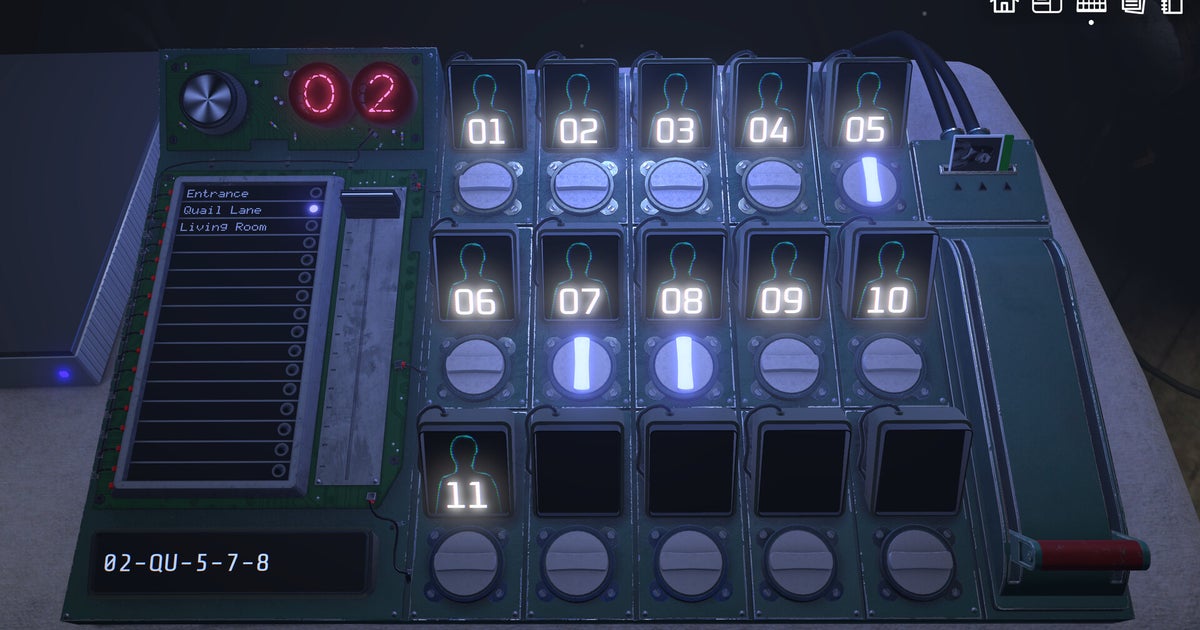
While Roottrees’ Steam version significantly polished and expanded the Itch.io original, Galley House is a total overhaul. Rather than plain text, the game’s scenes are represented by 2D art and a cast of voice actors delivering every line. And to access those scenes, rather than typing, you manipulate a kind of sci-fi gadget to input codes.
This last part was Johnston’s idea. He’d taken on a new day job at WB Games San Diego during Roottrees’ production, leaving Ward to finish it off, but the game’s success allowed him to leave that job (the studio was later closed by Warner Bros) and join Evil Trout as its second full-time member.
“Unlike Roottrees, it needed to work on Steam Deck, and potentially consoles”
He came up with machine as a solution to a problem they’d faced on Roottrees: it worked beautifully on mouse and keyboard, but in a way that didn’t translate to controller input. One of Ward’s core aims for this remake was that, “unlike Roottrees, it would work on Steam Deck, and potentially consoles,” Johnston says. “This meant not relying on a text interface.”
The result is a game that feels wholly different to Type Help – even before you reach the parts that have been dramatically expanded and extended. (No spoilers here, beyond Rous’ explanation of his thinking: “I’d never been particularly happy with the sudden ending of Type Help.”) Johnston, who was dubious that Type Help even needed a remake, is proud of what they’ve achieved here. “All I can hope is that people like it as much as I do,” he says.
Fingers crossed – not only because Galley House deserves success, but because it will define Evil Trout’s future. Johnston is confident he and Ward will work together on another game, but “what it is, and the scope” will depend on how this one performs. “The other members of the team, including William, will also be welcome to contribute if they’d like,” Johnston says, “but taking a risk on an unproven game that may or may not be a success is very daunting, so we’re leaving it up to them.”
Unproven? That’s right – Evil Trout is leaving behind the model that has powered its first two games. “I’d like to work on a game from the ground up rather than gilding another Itch game,” Ward says. “Jeremy and I have a few ideas for games, and over the coming months we’ll be exploring them and deciding on what makes the most sense to work on next.” That’s the plan, anyway. It’s always possible he’ll end up playing something that upends everything, all over again.
