


Many column inches have been spent questioning the wisdom of focusing on live-service. Sony gambled and lost, as did many other companies chasing the dream of steady recurring revenues, while firms like Capcom that stuck to the traditional path have emerged relatively unscathed.
Highguard was one of the more recent live-service casualties, a game that was reportedly backed by the Tencent subsidiary TiMi Studio Group. But Tencent itself is not shying away from the glittering promise that live service titles bring.
“I think our holy grail is live service, right?” says Yong-yi Zhu, VP and head of operations, strategy and compliance at Tencent Games.
“You look at Tencent’s DNA, it’s Honor of Kings, League of Legends, Valorant. They’re games that build upon themselves, and it provides stability to the studio, it builds communities. And I think more and more games are about not just engaging people for a short period of time, it becomes a lifestyle.”
The firm’s sprawling, constantly shifting portfolio aspires to support that lifestyle. But a wide-ranging conversation with Zhu confirms that live service is only one part of its strategy.
Evergreen dreams
A lot has changed since GamesIndustry.biz last spoke with Zhu just under a year ago. The UK studios Splash Damage and Bulkhead have gone independent, following similar moves from The Chinese Room and Secret Mode earlier in 2025. Zhu won’t go into details on the separation, but says “for certain studios we feel like we can’t help them amplify their game.”
.png?width=2048&height=2048&fit=bounds&quality=85&format=jpg&auto=webp)
“What’s really big for us is: does the partnership make sense? Are we bringing something to the table as much as the developers are bringing something to the table? And I think in those cases, either there was potentially a lack of synergy” – in terms of the games aligning with the firm’s long-term strategy – “or there were just better opportunities.” Ultimately, the firm decided they were “better standalone than they are with Tencent.”
“There are certain situations where we acquire a studio and actually we have trouble integrating them”
Zhu is sanguine about not all of the company’s many acquisitions working out. “There are certain situations where we acquire a studio and actually we have trouble integrating them because of market conditions or cultural differences,” he says. “Not everything, at the end of the day, is going to be a slam dunk.”
So what is the company strategy? Zhu says that evergreen titles are a key part of it – both single and multiplayer, with the former well-represented in the firm’s mobile games portfolio – but ultimately “it’s really about building sustainable communities long-term, having games that continue to engage with people.” And while live service is the holy grail, it’s not a singular focus. “It can be an IP that you build up,” says Zhu. “This is not our game, but you look at Call of Duty: we consider that an evergreen IP, even though it’s really one version after another.”

The ultimate aim is consistency: “You look at a lot of premium games: I think in the past, you’ve seen a lot of ups and downs with companies that launch a game and have to lay people off. I think more and more we’re trying to bring stability, and you typically don’t see Tencent doing the same thing.”
The other key part of Tencent’s strategy is investing in “really high quality talent,” says Zhu, again emphasising that “it has to be synergistic between Tencent and the developer.”
Doubling down
Zhu runs ops and strategy for Tencent’s global games business, and has around 20 studios in his division. That includes Miniclip, Sumo Digital, Funcom, Fat Shark, Sharkmob, 10 Chambers, and Stunlock Studios in Europe, as well as Digital Extremes in North America and Grinding Gear Games in New Zealand.

His focus is “less about places we’re about to go, and more about how we ensure these studios are successful in the launches that they’re about to have.” That includes making sure each receives appropriate support from the wider Tencent ecosystem on things like regional publishing, technical support, testing, backend services, or analysis: “Things like that where we provide expertise, because we’ve done it as Tencent in the domestic market, and now we’re trying to translate that into the global market,” says Zhu.
He gives the example of experts from across China and Europe coming to help out on Dune Awakening. “They’ll just sit alongside the devs at Funcom and work with them to solve the issues. And then afterwards, if it’s an ongoing issue, sometimes they’ll stick around. And sometimes we even say, ‘Look, if it works out, the person can go to the studio and be a permanent employee’.”
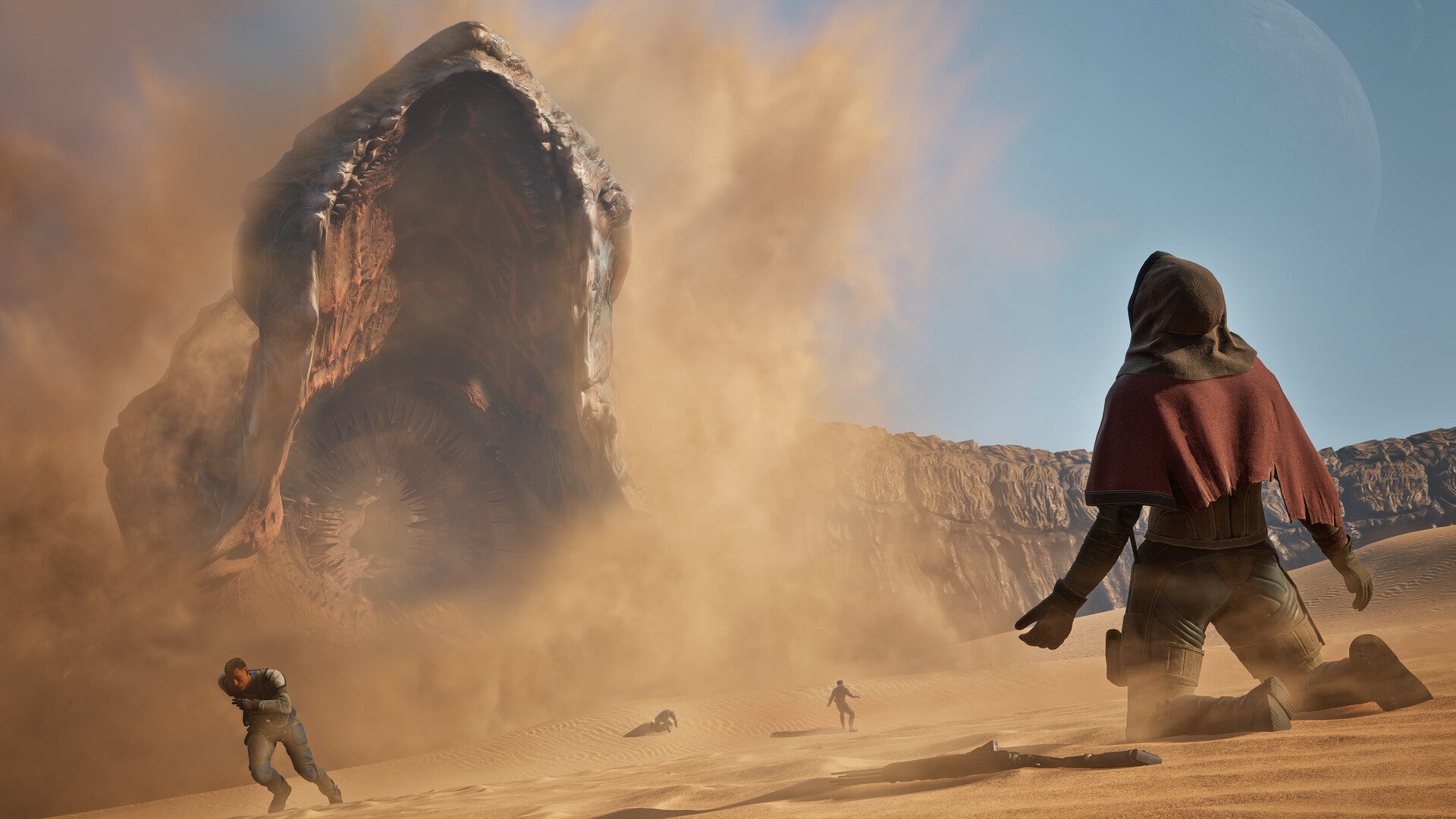
He clarifies that things like creative and artistic design are mostly left to individual studios, but Tencent might swoop in to help on issues that are common across studios, like particular issues with Unreal Engine, or help with publishing in certain regions like MENA or Southeast Asia.
A question of scale
Funcom saw a wave of redundancies last October, and the Funcom-owned studio The Outsiders, maker of Metal: Hellsinger, was closed. At the time, Funcom said that the aim was to “focus our internal resources on releasing new content, features, and enhancements” for Dune Awakening. So is Tencent’s strategy to focus more on bigger, live-service titles rather than smaller projects?
“It really depends on the studio to be honest,” says Zhu. He notes that Funcom had already been running the live-service title Conan Exiles for a long time when Tencent bought the studio. “So that’s a part of their DNA. They design games to be live services, and we support them on that journey.”

Other studios in Tencent’s portfolio, meanwhile, have tried live service, but it “didn’t work out,” and they have “now focused more on premium titles, because that’s been their bread and butter. And for us, we really want to help build studios that are best in class in their craft, whatever that might be.”
But how small is too small? Joe Brammer, CEO of Wardogs maker Bulkhead, told GamesIndustry.biz earlier this year that Tencent “wouldn’t look at any game that was less than £50 million.”
“I don’t think there’s anything that’s stopping us from making smaller games”
Zhu disagrees. “I think we look at games across all scales, to be honest. I think for us, it’s more about where the studio is on its journey and what its end destination might be. Could we help them get bigger? Sometimes we feel like, hey, our expertise doesn’t quite match, or maybe the cultures don’t match, but I don’t think there’s anything that’s stopping us from making smaller games. We do have small games in our portfolio.”
He describes Larian Studios and From Software are “north stars” in terms of Tencent’s studio investments (the company owns a minority stake in both), and that they have “built up games over time, and not all of those games have been very big, but all of those games have been purposeful and have continued to build on the audience, and have continued to help them build on their craft. I don’t think it’s necessarily true that we don’t look at smaller games.”
Exdev
Last time we spoke, Zhu talked about spinning up some Chinese support teams, with the idea of tying Tencent’s Western and Chinese arms together more closely. A year later, he says not as much progress has been made on this front as he would have liked, in part because of challenges working across different time zones. Instead, the focus has switched to trying to instill learnings from different studios across the group.

But he does see a future in the model of smaller, core teams being supplemented by external development: a model that has worked well for Star Wars: Galactic Racer. “At a high level, I think that makes sense,” he says. “We were looking the other day at the development life cycle of Expedition 33, and it’s a very similar story.”
“For us, it’s kind of how many people should we keep on staff and how many people should we then leverage from an outsource vendor? Sometimes it’s like, ‘Hey, we need high precision folks that are making very intricate things, and we would like them to all be in a certain location working together.’ And that’s kind of the prerogative of the studio head.”
Location has proved a key factor in outsourcing, with some teams happy with distant partners, while others look for help in the same timezone. “And so we’re looking across the globe at what the options are for our different studios. Sumo is potentially going to support our studios in Europe, because they’re closer. But being in the UK, it’s probably not the cheapest place to be. So you have trade-offs on these types of things.”
“North America’s a tougher and tougher place to be, unless you have a very solid dev team that has worked together for a long time”
This brings to mind Amir Satvat’s fascinating keynote speech at Gamescom Dev, which pointed out that jobs are disappearing in expensive locales like California, but opening up in regions like Asia. As Satvat put it: “Head count moving from basically North America to basically anywhere else.”
Zhu agrees that in general, “North America’s a tougher and tougher place to be, unless you have a very solid dev team that has worked together for a long time. I came previously from Activision, where we were roughly all in the Santa Monica area, but it’s a team that’s delivered content year over year over year over year.” For support teams, though, “it doesn’t make sense to be in such an expensive part of the world.”
The shift to AI
It was notable that this year’s Gamescom Opening Night Live featured a large number of highly polished games from Chinese studios – which leads us to wonder whether we’re seeing a power shift in the games industry from West to East.
“I would say I hope so,” laughs Zhu. “I was born in China. But I think the reality is games like [Black Myth] Wukong really inspired people to make really high quality content. They now know what really, really good looks like for console and PC.”
“I think a lot of Chinese developers are like, ‘I know how to make high quality mobile games’, and now they’re like, ‘Oh, this is what good looks like for console and PC’. I think probably in the past they’ve done a lot of art outsourcing and things like that that were a little bit lower level, but now they’re like, ‘We know what it looks like.’ And then probably they have better tooling that can help them on things. And so it cuts that barrier and that gap.”
“China in general really loves AI as a tool”
That better tooling includes “things like AI that can help people iterate more,” says Zhu. “And AI for us is not about replacing people. It’s about making people more effective and efficient across a number of different things. We have development teams that are a bit smaller, but they’re like, hey, now we can make more content, we didn’t want to be a big development team. We like our family feel of 30, 40 people, but now we’re able to make higher quality things, and iterate more, and come up with cooler looking – whatever it is that they’re designing.”
“I think that’s probably true of the Chinese developers, too, because they’re kind of growing up in this age of leveraging tools,” he says. “China in general really loves AI as a tool.”
In the West, by contrast, developers tend to be more reluctant to use AI, with ethical concerns, copyright worries, and player backlash all front of mind. “I think people should just not be afraid of AI,” says Zhu. “It’s like the internet, it’s coming. And I spent some time personally to figure out what is the best way to leverage AI in my daily life to make myself more efficient.”
“I think people should just not be afraid of AI. It’s like the internet, it’s coming”
He thinks that development teams should be more “open to that way of thinking” and should consider AI as “a genuine tool.”
“And there’s honestly so many tools now, whether it’s in coding, whether it’s in art, whether it’s in whatever else you’ve got: it can do so much for you.”
He says that Tencent generally encourages developers to use AI, “because we think there’s a lot of potential, but again, as a tool. I think on content generation, that’s a very different conversation. I think that’s probably further away. For development, it’s more like we use this for concept art, we figure out what it’s like, then we’ll use AI tools for rigging, for motion matching, for code review. There’s so many different things in the pipeline that [AI] can do. Even production management tools, they’ll have AI bots in their Slack channel asking people for homework and things like that. So it can be used in a number of different ways that’s not replacing humans, right?”
He acknowledges that there are still some difficulties to work through, not least when it comes to the copyright status of content produced via generative AI. “I do think that’s something that the AI industry will have to figure out,” he says. “Let’s say the AI is only using our own libraries, right? That makes it very easy, because that’s our IP, we’ve done it in the past, and they’ve remixed that content into something else. I think that’s OK versus using something that’s from a different content creator or just the general web. And we look at that very closely. We make sure that our data is confined to our studios.”
This includes agreements with each tool provider to ensure that data doesn’t end up being accessible outside the building. “What we don’t want is our developers creating things that then get picked up from somewhere else, and then suddenly you’ve got versions of our things in a different game.”
.jpg?width=2048&height=2048&fit=bounds&quality=85&format=jpg&auto=webp)
With the backing of its vast parent, Tencent Games is in a position to experiment, placing bets large and small on a wide variety of products and studios. While it’s recently retreated from Bulkhead and Splash Damage, and redirected AAA studio Lightspeed, our conversation took place the day after it announced a minority investment in W4, the commercial development partner of the Godot engine. It seems likely that come next Gamescom, Zhu will have some different projects to talk about. But the throughline is engagement, whether via live service or not.
“At the end of the day, I sit in games, which is a part of a bigger Tencent ecosystem, and my purview is always about how do we keep people engaged, make sure that they’re having fun,” he says. “Because, to say in a crass way, that translates to the bottom line. The more people love your game, the more they’re going to play your game.”