


Three years ago, we launched our Kickstarter campaign for Trash Goblin, our cosy shop sim. It was an existential moment for Spilt Milk Studios. Seventy-four publishers had turned down the game – one of them pulling out in the meeting that we thought was to sign the final publishing contract – but players seemed to love it.
We put the team on notice of redundancy, and launched a last-ditch effort to save the game and the studio.
Fast forward three years. Trash Goblin successfully crowdfunded, launched into Early Access, released on Steam, Epic, Xbox, PlayStation, Switch, iOS and Android and has a plethora of DLCs, both free and paid.
As we prepare the Kickstarter campaign for our next game, we went back to look at the funding sources for Trash Goblin. To our surprise, crowdfunding was only 10% of the budget of the game. This encouraged me to take a deeper look at how a modern indie game studio builds the funding to make a game, and why asking “What is the budget for your game?” doesn’t make sense in 2026.
The chart above shows the sources of funding for Trash Goblin up to the 1.0 release. The key dates:
- Demo release and crowdfund: November 2023
- Early Access: November 2024
- 1.0 release on Steam: May 2025
- Console release: May 2026
Players accounted for over one third of the funding, through the initial crowdfunding campaign, and the revenue from Early Access that we reinvested into the title. We had enormous support from the UK government, representing around one third of the budget as well. We benefited from the Prototype Fund and the Content Fund for Trash Goblin, which is a competitive process for a limited pool of money, while nearly every British developer can get Video Game Tax Relief (VGTR) or its replacement, VGEC. We also invested our own resources, particularly at the beginning of the project to get the demo up and running, resources that included company reserves and the margin on work-for-hire development. Finally, we had support from Microsoft for bringing the game to Xbox.
The main surprise for us was that Trash Goblin is seen, both internally and externally, as a crowdfunding success story, yet our Kickstarter funds were such a small percentage of the development budget of the game.
This, I think, is one of the key changes to indie development in 2026. Many developers think of Kickstarter as a replacement for publisher funding. It is not.
Publishers are project financing. They (usually) pay for the majority of the development of the game, in return for getting most or all of the revenue from the game until they have recouped their investment, and sharing the revenue with the developer thereafter. This can be great for developers, allowing them to focus on making the game, not worrying about marketing or financing, but it can also kill studios, as Tim Bender of Hooded Horse has argued.
Kickstarter doesn’t fit that mould. Occasionally, a studio can get lucky enough to fund the entirety of the development of their game with a crowdfunding campaign. More often, it is a step on a journey towards a successful launch. More importantly, it can be a key part of your marketing, community building and market testing.
We have recently been asked what the budget is for our next game, Gobble Inn, a cosy rogue-like (think “Diet Dave the Diver”). Our answer to how big is the budget: It totally depends on when during development you are asking the question.
The image below shows how we are thinking about the development of the game
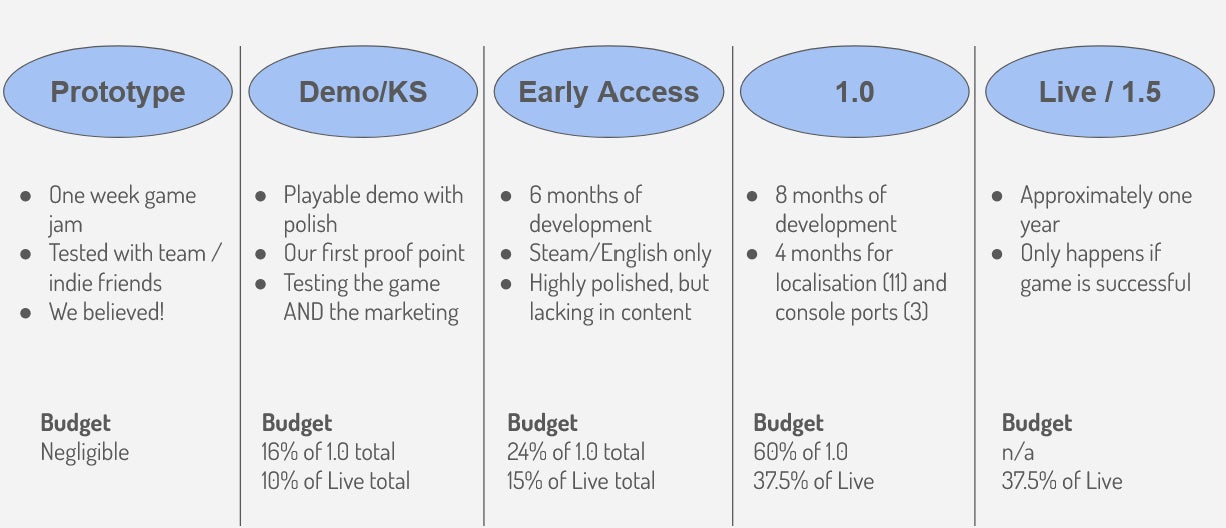
Our initial prototype was developed in a three day game jam last Christmas. We found gameplay we believed in and that the team wanted to make.
Alongside continuing to support Trash Goblin with paid and free DLC, we have been working on polishing a playable demo. We believe that the days when you can crowdfund a game on the basis of a PowerPoint and the track record of the team are long behind us. Assuming that the crowdfund is successful – demonstrating real customer demand for the game we want to make – we will then commit to delivering an Early Access title. If the Early Access demand is weak, we will continue to work to keep all our promises to players, but not push the boat out on new features. If, as happened with Trash Goblin, demand is strong, we will continue working to a 1.0 release, fully localised and, hopefully, on all platforms, as well as supporting the game after 1.0.
“The budget for Gobble Inn is anywhere from £250,000 to £2.5 million, depending on when you ask”
That means that for our team of 10, supported by freelancers and specialists from audio design, marketing and merchandising, the budget for Gobble Inn is anywhere from £250,000 to £2.5 million, depending on when you ask.
That is the key takeaway here. Our mission at Spilt Milk Studios is to delight players by developing cosy, wholesome games, crafted with a twist. To do that, we have to survive. We believe that is best done by having a flexible development process. We commit a certain amount of money to the next milestone, work hard to get the development, publishing and marketing right for that milestone, and then adapt our plans, including going to Plan B, C or even D, as we get feedback from the players and the market.
There are other ways to survive as an indie. Publisher funding still exists. New funds that invest in projects are emerging. But we want to control our own destiny and not have a person in a suit able to decide that our game is not a priority for them any more and shut it down. Finding multiple sources of funding, with a flexible approach to committing that funding, is the route we have chosen.
Nicholas Lovell is the Product and Strategy Director of Spilt Milk Studios. Gobble Inn is currently crowdfunding for £50,000 on Kickstarter.