


Fable is finally set to be released on February 23, 2027, after being pushed back from its autumn 2026 launch date earlier this year, and having previously slipped from a 2025 release window. The game has been a long time coming: it was announced in 2020, but development reportedly began several years ahead of the game’s official reveal.
In the meantime, a lot has changed, with new leadership at Xbox leading to a swathe of studios being cast off, as well as sweeping redundancies. Amid all that change, British studio Playground Games has been juggling its work on the Forza Horizon games with the continued development of Fable, attempting to live up to the expectations of Lionhead’s original trilogy while aligning the reboot with modern standards.
Speaking to GamesIndustry.biz, Playground Games co-founder and now Fable general manager Ralph Fulton explains the course of Fable’s development and the decisions made along the way, as well as why making it using an engine designed for racing games was the right call.
You’ve previously said that humour is a huge part of the Fable franchise, but what were the other core pillars that you started out with, and have they changed since the beginning of development?
I say this with some pride – tempered against the fact that this has been obviously an enormously long development, so clearly not everything has gone well – but I would say that our original vision of what Fable needs to be has remained unchanged.
Somebody asked me yesterday, ‘What was the one thing you had to get right?’ And I kind of laughed, because there’s six things that we had to get right, because they are part and parcel of what Fable is and the expectation that people have of a game which bears that name. And I think if we were making a brand new IP, we’d cut three of them straight off the bat, because you’d be nuts to go after it.
There are many reasons that this game development has been long: it’s a new team, it’s a new genre, a new franchise, new technology – although we’re building in an engine that we know well. It’s also because a Fable game must have a great story with memorable characters and high-stakes drama, and also it needs to be funny and to have that British wit infused throughout it. Then there’s combat, the quest structure, and the world of Albion and its people, and the simulations that underpin it. You’d be nuts to take on all of that in the first project, and yet here we are.
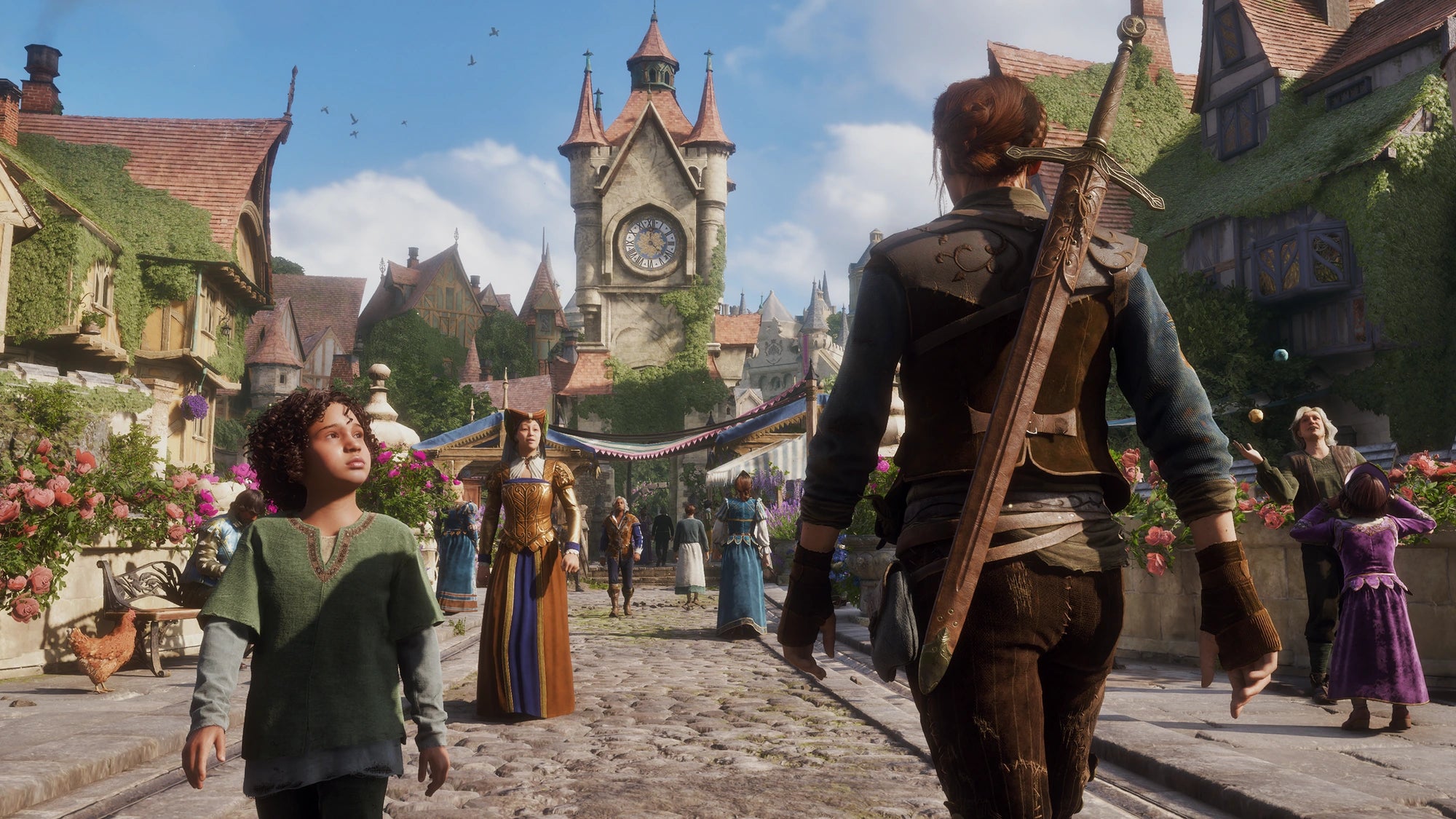
Can you give any examples of what’s changed over the course of the development?
Principally, technology has advanced. In 2015, The Witcher 3 redefined what an open-world action RPG looks like and became the gold standard. And after that bar was raised, the Assassin’s Creed franchise changed into this more modern iteration with Origins, Odyssey, and Valhalla, and became like a quasi-RPG.
All of these games continue to reset player expectations, which means I think looking only to the original Fable trilogy for inspiration would leave us lacking in terms of what the modern audience, the modern marketplace, expects.
Given that, have you had to continue widening the scope of the game?
I would say no. If anything, our scope has decreased – and there’s no scandal there, that’s the natural course of game development. So no, but we did start with such an enormous potential scope, because there are a bunch of things which are the price of doing business if your game’s called Fable.

One of the things that Fable games did back in the day is they were one of the first to really tackle morality. And then in the intervening period, lots of other games in the RPG space and beyond tackled the concept of morality, and arguably started offering a more realistic or nuanced take on it, such that when we came to look at it, it wasn’t just with the backdrop of the original trilogy. That’s where we started, and where we’ve ended I think is somewhere even more interesting and more granular almost, but it is a distance from the original games.
In terms of the world responding to the hero, did that become more complicated as you went along? Have expectations risen, and have you had to make that more advanced?
Not from a competitive landscape perspective, because that’s one of the things that none of our competitors do. It’s totally a Fable thing, the social simulation and economic simulation. Okay, there are games that have economic simulations, but they’re not in [our] RPG category. Fable is unique in that it’s almost like a life sim in terms of genre.
We made a smart decision early doors that we would only model first and second degree ripple effects, because we felt that players would only notice or we could only communicate the consequences up to the second degree. If you can imagine the domino effect…
Yeah, you could go full Dwarf Fortress.
It was important because we could have chased that rabbit down a really, really deep hole for little reward. The complication comes when you play it and you go, ‘Well, this is functioning as designed, but I would expect this person to do this in this scenario’. And then you have to make a call almost on a case by case basis: ‘Okay, let’s build that in’. But knowing that, again, you could be going down a huge rabbit hole with little payoff.
Part of the fun is sometimes [the systems] come up with [bizarre] results. We still run into those and go, ‘Should we fix that?’ And more and more we’re like, ‘No, it’s funny’. It’s funny in a systemic way.

You mentioned this has taken a long time, would you have started this project if you’d have known how long it was going to take?
I don’t think I can answer that question, honestly. I have definitely felt an enormous obligation to finish it for two reasons. First, for the team, because we assembled this team from scratch. It took an enormously long time and people came from all over the world. And the reason they did wasn’t because they wanted to work for Playground Games, it’s because they wanted to work on Fable. So I’ve always felt a debt and obligation to them that we not only finish this, but finish it well and make it successful.
And second, as soon as we said in 2020 that we’re making a new Fable game, we created some kind of contract with Fable fans all over the world that we’re going to bring it back and we’re going to do right by the franchise that we all love.
On the tech side, is there still a Forza engine at the heart of it?
Yeah, 100%. So this is still the ForzaTech engine as we know it. Foundationally, it is the same engine, and we have benefited enormously from being able to use the architecture of that engine and some of its core features which have contributed to the success of the Horizon games.
There’s many reasons that we chose to use what I think to outsiders looks like an odd choice, because it’s a racing game engine. But it’s only really the top layer that makes it a racing engine, and it’s the layers beneath that make it a great engine for us to develop in, with powerful rendering features that allow us to make just breathtakingly beautiful games.

But we’ve had to build things which Horizon has never needed. It’s never needed to make great looking characters that can convey the performance of an actor you know, it doesn’t need quests, it hasn’t really ever needed cinematics to the level that we’re building, it hasn’t needed animation anywhere near the depth this game has done. We’ve had to build an enormous amount. It all comes at a cost and it takes time to build, but yet it’s still the ForzaTech engine.
I think principally the reason that we felt we should continue with that engine rather than get something off the shelf is because we know how to ship games in ForzaTech, and that’s important. Knowing what your path to finish looks like is a really important thing in game dev.
There’s been a lot of turmoil at Xbox: has your backing from them been consistent, and has the fact that you’ve continued to ship Forza games helped to earn your keep?
I mean, it does not harm us that Playground’s reputation around the world and internally at Xbox is founded on the success of Forza Horizon. So that’s a huge benefit to us.
I don’t think anyone, even new people coming in, weren’t quickly appraised of the status of the project, because no one’s ever in the dark with that. When we chose to move our launch date back, everybody was involved in that decision. Big organisations like this, they do run on communication, and therefore no one has ever turned up and gone, ‘Hey, you’ve been running a long time’, because everybody internally knows the narrative. And I think, and this is something I’m incredibly grateful for, [they’re] just incredibly committed to bringing Fable back.
The game was described as being handcrafted, so just to pick at the eternal controversy of the moment, there’s no AI in there or anything like that in the game’s performances?
Absolutely. The voice production for this game has been staggeringly complex and long. This year alone, we put in a thousand hours in multiple studios. Our dialogue team were recording sessions in parallel, back to back, every day of this year just to get through the number of actors that we have and the number of lines. Over a hundred voice actors from all over the UK have contributed to this game, recording over 150,000 lines of dialogue. It’s a mammoth operation.

We were really keen to make sure that there are accents from every corner of the UK, not just your standard fantasy RP accents, but someone from Sheffield, someone from Belfast, someone from Edinburgh. And that brings a certain amount of humour to it naturally, because with regional accents, you have funny ways of expressing things, and I think that just adds to the Britishness of the game.
It feels like there’s a very racially diverse cast in there as well, was that a key thing you wanted from the outset?
I think what we wanted to do is represent modern Britain today. So that’s kind of the precept.
Someone else asked me, ‘How’d you go about casting?’ And I think honestly, the answer was a bit naively. We just created a wishlist of people we really admire, people whose work makes us laugh, and then we reached out and said, ‘Would you be interested?’ And suddenly we’re on a call with Hayley Atwell [who plays Agent Peggy Carter in the Marvel films], trying to explain Fable to her. But I think the thing that she really loved right from the start was she got the character of Isabel. She saw something in her.

My perception is that Fable never really had a very elaborate combat experience, so what was the thinking behind really building that out in the new game?
I would maybe take slight issue with you on that. Yes, I don’t think Fable was ever a combat game, and I think they made a conscious decision to bias towards approachability. I think that sometimes comes off as simplistic, but I think it was intentionally so.
For us, our first port of call was always, OK, what did the original trilogy do? What were they going for? Where were they successful? When did they maybe fall short? But we always balanced that with a much more contemporary competitive landscape analysis. What are the games that we would want to be compared favorably to, that we would want to stand shoulder to shoulder with? And how do they approach combat? It’s always a bit of an amalgam of the two.
This interview has been edited for length and clarity.