



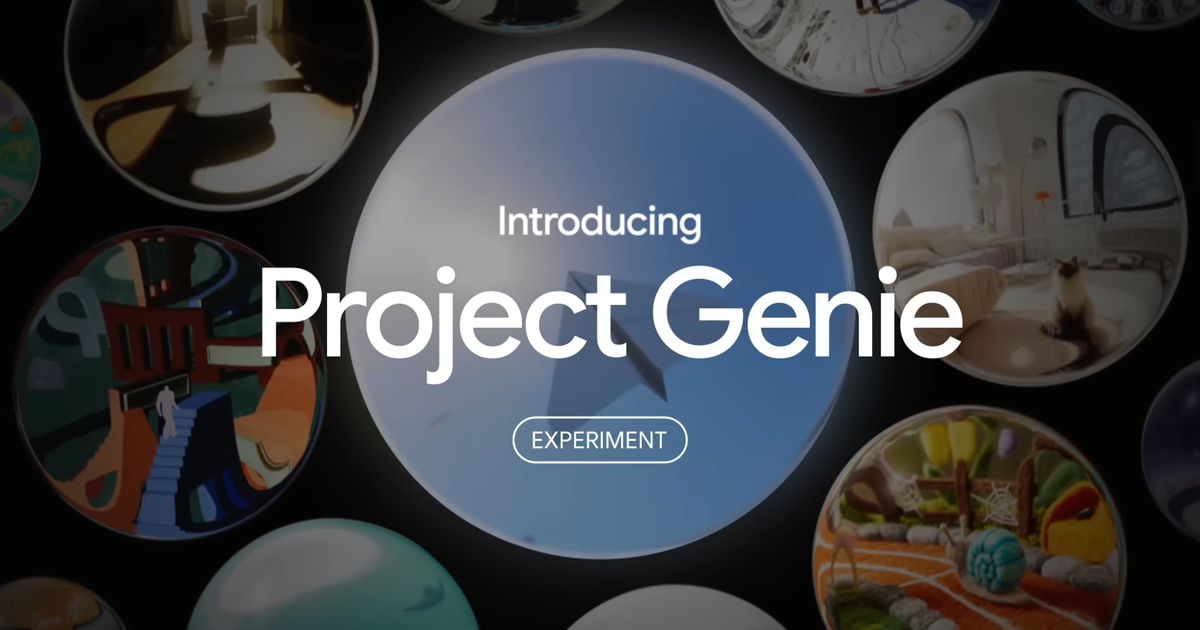
Tech giant Google has started to open access to its latest AI tool, Project Genie, which allows users to create “playable worlds”.
In a video, Google’s DeepMind artificial intelligence research division shows that people can generate this content with just a prompt, similar to other generative AI tools. This does come with some limits; Google says that: “Generated worlds might not look completely true-to-life or always adhere closely to prompts or images, or real-world physics.”
But that’s not the only issue that faces Google and Project Genie. In the aforementioned video, the tech firm said users can “be any character”.
Well, as reported by VGC, users are already taking to social media to showcase content apparently generated by the technology using copyrighted characters and IP, such as Shadow the Hedgehog and The Legend of Zelda: Breath of the Wild.
Speaking to GamesIndustry.biz, Pete Lewin, a partner at law firm Wiggin, argued that Project Genie raises many of the same problems that other publicly-available artificial intelligence tech does.
“Whilst the interactive nature of Project Genie’s outputs is novel, the tool itself raises all the same legal and ethical questions as other generative AI image tools,” he said.
“What data was it trained on? Where did that training occur? Was that use permitted under copyright exceptions and so on? Many of these questions are being tested in courts around the world right now.” He added that tech such as Project Genie can expect to face “greater scrutiny and pushback from IP owners”.
“Allowing fans to recreate their favourite game characters in static images and memes is one thing,” Lewin continued. “Allowing them to create entire game worlds which could one day begin cannibalising their own official products is another. Some AI tools have started embedding IP protection mechanics into their systems, preventing people from generating famous IP, celebrities and so on. Genie is obviously still in relatively early-days testing, though, and similar guardrails will undoubtedly be introduced over time.”
In an accompanying blog post about Genie, Google emphasised that this is an “experimental research prototype” but said that it is building the tech “responsibly to benefit humanity”.
Limitations on the tool include worlds not looking “completely true-to-life or always adhere closely to prompts or images or real-world physics” as well as generated characters being “less controllable”.
Google makes no mention of restrictions on copyrighted IP.
The company continued: “We look forward to seeing the infinitely diverse worlds they create, and in time, our goal is to make these experiences and technology accessible to more users.”
GamesIndustry.biz has reached out to Google for more details.
