



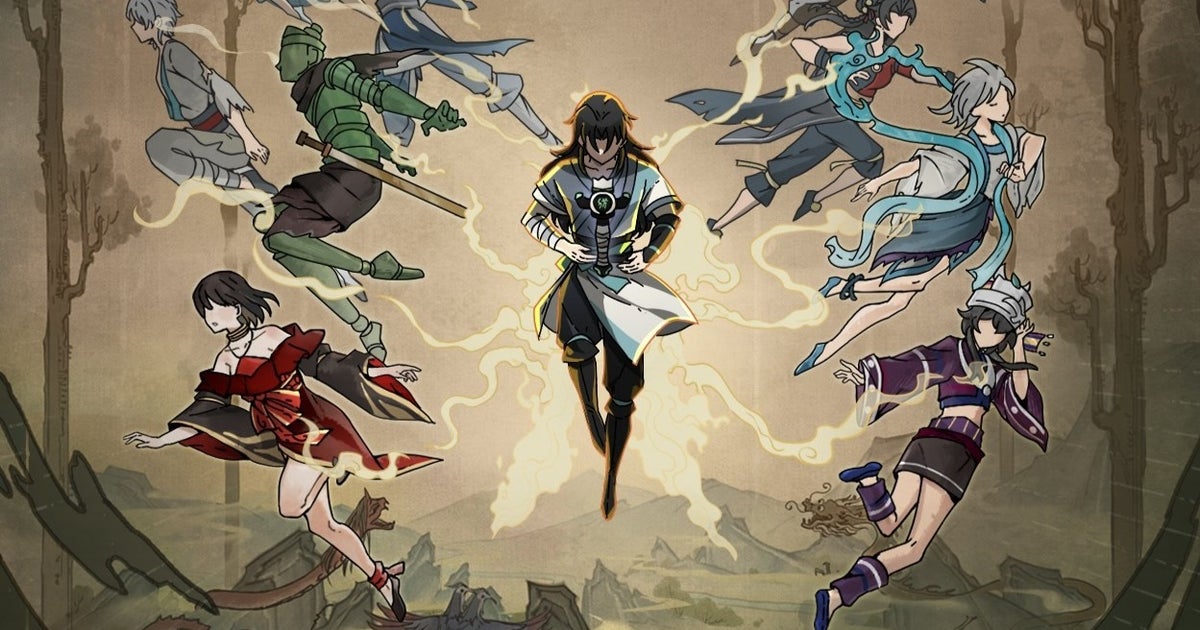
Long before the global success of Genshin Impact and Black Myth: Wukong, The Scroll of Taiwu from ConchShip Games pointed towards the potentially huge market for Chinese-developed titles.
The game, an RPG based on wuxia and Chinese mythology, launched on Steam in Early Access on September 20, 2018, at a point when Steam’s Chinese audience had rapidly expanded to more than 30 million users. Niko Partners analyst Daniel Ahmad noted at the time that Steam had originally gained popularity in China thanks to the rise of Dota 2, but the addition of more China-developed and Chinese language games, as well as regional pricing and local payment methods, had helped attract more gamers from the nation.
Within two months, The Scroll of Taiwu had sold more than one million copies, and would go on to attract more than 3.4 million players. Western players quickly noticed the novelty of a game without English language support racing to number two in the Steam bestseller charts. In the years to come, of course, they would be no strangers to seeing Chinese-made games in Steam’s top echelons.
Now, as The Scroll of Taiwu finally leaves Early Access – launching with full English language support for the very first time – the developers discuss the evolving Chinese market, the importance of community engagement, and the thorny topic of AI.

Zheng Jie (who goes by the name Qiezi), founder of ConchShip Games and lead developer on The Scroll of Taiwu, says the studio has spent a long time discussing exactly why it was that their game became so popular. He thinks it was because it stood out. “For indie games in China in the past, there was a blue ocean, and we were doing a very original work,” he tells GamesIndustry.biz, via a translator.
Ten years ago, he says, lots of Chinese games were influenced by Japanese RPGs, but ConchShip decided to create something original that was centred on the Chinese genre of wuxia. “It was very different from others, because it has a very interactive structure, and the players got a lot of freedom to explore the different mechanics.”
Targeting China
The Scroll of Taiwu is a premium PC title in a Chinese market that’s dominated by free-to-play games. But Qiezi says that right now, people’s interest towards premium PC games is getting stronger. “We have added hundreds and thousands of wishlists just last year, because Chinese players are constantly looking for good content to play,” he says.
Qiezi says that any Western developers that want to target the Chinese market should focus on the story and culture in their games first of all, because with compelling lore in place, players “are more willing to spend more time in that game,” he says. “So the kind of story and ideas you’re bringing to the Chinese market is very important.”
It’s notable that it’s not just games about Chinese culture that do well in the country – Kingdom Come Deliverance 2, which is centred on European history, has done very well in China. Alinea Analytics estimates that over a fifth of the game’s revenue came from China.
.jpg?width=2048&height=2048&fit=bounds&quality=85&format=jpg&auto=webp)
Qiezi says that rather than being focused on game mechanics first and foremost, “Chinese players are more into learning a different culture… They’re open to a lot of stuff.”
Some of the biggest mistakes Western companies make when bringing games to China tend to be around localisation, says Liuyi Xu (who goes by the name Mutong), lead artist for The Scroll of Taiwu. Often this comes in the form of poor translation, he says. “And also, lots of successful Western games, they like to add Chinese elements or Chinese content to a game, but those elements are not Chinese enough. And the players, they can see through that.”
The main thing to focus on is engaging with Chinese players, he thinks, adding that even without good localisation, a game can still be successful in China if the developers engage with players and accept feedback.

Community engagement in China involves completely different platforms from those that Western developers might be used to. Qiezi says that The Scroll of Taiwu grew its community across a whole host of social media sites, including the online forum Baidu Tieba and the video platform Bilibili, as well as through multiple chat groups in QQ and WeChat. The game also has a large presence in Little Black Box, a popular gaming news and encyclopedia app. “In China, the community is not in a very centralised place like Discord,” Qiezi says. “Chinese players like to use the social media platform they are familiar with, and that’s why there are so many different platforms out there.”
Going the other way, from China to the West, has also involved some adaptation. The publishing advisor for The Scroll of Taiwu, Leye Yu (who goes by the name Yager), says that he spent time researching Western community platforms, and he came to the conclusion that most of the game’s players were focused on Discord, where people had been working on fan translations into English.
.jpg?width=2048&height=2048&fit=bounds&quality=85&format=jpg&auto=webp)
He thinks that although it can be helpful to have someone local doing community engagement, it’s not essential as long as the developers are honest and close to the players, even if they have to use an AI translator. “In my opinion, I think the most important thing is you need someone that really shares the same perspective with the players, does the same thing as the players do, plays the same content as the players play, and runs into the same issues, the same bugs as the players run into. If you know what they are talking about, and you know what they are worrying about, then you can give them the correct feedback and give them what they are expect.”
AI and a changing market
Looking ahead to the future of the Chinese games market, Qiezi says that not only is it getting larger, it’s also changing in terms of its makeup. “Small to mid-size teams are a trend in China,” he says. “In the past, the ConchShip team were one of the few studios the players could see or could know, but now more Chinese studios can survive by just developing a good game in China. That’s a very big difference, and it applies to lots of popular games recently, like Black Myth: Wukong and other popular Chinese indie games. So the Chinese PC market is definitely growing rapidly, and it will continue to grow larger.”
Just as we’ve seen the slow-burning indie revolution take hold in the West, the same thing is happening in China. “Technology is not the gatekeeper [any more],” says Qiezi. “You don’t really need to know coding now, but content creation and creativity are key for game creation.”

Which brings us to ask about generative AI, a technology that Chinese game makers have embraced to perhaps a greater extent than in the West, particularly in the mobile sector. Qiezi clarifies that no AI was used in the development of The Scroll of Taiwu. “But I think AI can be used as a tool and people are allowed to try it,” he says. “Not in game creation, but more in management work or as a tool to reduce the burden of communications. For a game, it needs to be unique and to be something that people didn’t think of before or couldn’t imagine before, so those kinds of artworks could not be produced by AI.”
Yager agrees, saying that game creation is a combination of performance and expression to deliver someone’s dream, whereas generative AI offers only duplication of others’ work. “How dare we use something like that on someone’s dream? We have to be creative and do something that can only be done by humans.”
Although Chinese players are curious about AI, says Qiezi, use of the technology risks cheapening a game in the eyes of consumers. “If you are asking for money for that AI-generated content or those games, especially [where the AI use] can be noticed easily, that gives a feeling that the developers want to take a shortcut.” That is exactly the opposite of what ConchShip has done, he says: carefully listening to players, building trust, and refining their game using their feedback over the course of more than seven years. Using AI would risk it all. “Once that kind of trust is broken, it is very hard to fix.”
