



Last year, the digital distribution platform VaultN partnered with Take-Two Interactive, having already secured customers such as Bethesda, Team17, Landfall, and Curve.
VaultN co-founder and COO Julian Migura outlines how the platform aims to centralise transactions for publishers, distributors, and retailers, as well as addressing challenges such as outdated payment systems that cannot keep pace with the scale, speed, and level of automation needed.
“The system is built so it can be used by anyone from solo devs to large-scale organisations,” says Migura. “We’re aiming to increase capabilities and make it fully self-service over time. We’re not there yet, but the goal is that anyone can join the platform and use it to unify their commercial environment within the industry.”
Migura notes the platform is “growing nicely,” and they aim to add two or three new partners every week. “To some extent, it’s a never-ending job because new channels pop up and the definition of a channel varies. We’re enabling many connections to individual partners; it’s not a one-to-one relationship. If a channel integrates, they’ll have access to tens or hundreds of publishers, depending on who chooses to work with them through the platform.”
“In principle, we want to empower everybody. What we see is that these additional channels can increase units sold by up to 20% over the lifetime of a game. So it makes a big impact for anyone.”
VaultN currently partners with the Epic Games Store and GOG, but has not yet reached an agreement with Steam, which Migura calls the “holy grail.”
“Steam is the biggest player and platform on PC, so any solution we build without them would not be as good as it could be. It’s in our interest to partner with Steam, but with the major publishers, support, and partners we have, it’s hopefully relevant enough to see if we can enable something that makes it easier. By easier, I mean not just for publishers, but also for Steam and VaultN.”
“The important thing for us is making a system that enables publishers to, for example, issue keys in an easier way, where it can be automated and only done when there’s an actual sale to a consumer.”

Although Steam is not yet integrated, clients can retrieve keys from Steam and use VaultN’s database to distribute them to other platforms.
“We can securely hold this inventory, which is then distributed to designated partners on demand. Traditionally, you would send Excel files with keys by email from A to B and wait for someone to report sales. In our case, the key is encrypted immediately and never seen by anyone until a final transaction with a consumer is approved based on business rules each publisher defines.”
VaultN takes a small percentage of publisher royalties generated through its system. “We are completely aligned with publishers, maximising long-term revenue through the platform,” Migura explains. “If they give a higher cut to a retailer, we will have a smaller piece of the pie because our shares are assigned to theirs.”
VaultN’s fee is deducted from the publisher’s share. For example, if Steam takes 20%, VaultN’s fee applies to the remaining 80%, usually between 3% and 5%, depending on the publisher’s revenue margin.
“The most important part is that it doesn’t impose fixed costs,” Migura stresses. “It was important to us that it can grow with a partner. So if you’re a small indie with few sales, you’re not hampered by having to pay $1,000 to handle this.”
“It’s simpler for the publisher to get the biggest upside by orchestrating their partnerships through a single system”
“We also innovated because previously on the distribution side, it was common to charge both sides, especially with high fees on different retail or other distribution channels. We’re trying to step away from that because we believe it’s simpler for the publisher to get the biggest upside by orchestrating, managing, and controlling all their partnerships through a single system. They should be the ones paying for it. If they wish to pass it on, they can.”
Migura clarifies that VaultN does not handle payments; it only manages key or unit distribution.
“We handle all reporting in real time, but we don’t handle the collection of funds. That’s done directly between the publisher and its partners. We’re looking to enable this too, but it’s still in a very early stage. We aim to provide functionality for publishers to automate this, but we’re not there yet.”

Beyond providing a straightforward distribution system, VaultN also aims to address the challenge of product discoverability.
“What we’ve seen is that product visibility needs a more cohesive and structural approach,” he says. “Often, publishers don’t understand users who play their games across multiple channels. Big companies have the infrastructure to do this, but many smaller ones do not.”
“We are a B2B infrastructure company, but our mission is to give tools to publishers and studios. Anyone in gaming can create an ecosystem that functions together. Steam is a fantastic platform and the default for PC, where we are most active. That means some saturation. We’re trying to reach players where they are, which is not always possible on the platforms. Sometimes different channels, existing for years locally, are needed.”
Migura continued: “Part of distributing is making sure people can see your product where they are and want to buy games. Another part is enabling them to buy those products. In emerging markets, you may not have access to Steam, or Steam may not support your payment method or local currency. That’s the basic part we’re trying to enable for publishers.”
Migura states that by streamlining business processes, VaultN helps platforms reach smaller storefronts in non-Western markets, such as Japan and India.
“We do business development ourselves where we reach out and have conversations with bigger partners or potential partners in different markets where we believe there’s a bigger opportunity for gaming,” he says.
“We decided to build a platform that is unbiased and not aligned with anyone but provides a toolkit”
“We act as a normalisation gateway from a technical level, so it doesn’t matter how a product is delivered or what platform it’s delivered on. Our system handles all those different layers. From a retailer’s perspective, it’s a single API to integrate with, and they can access any partners in the network, but they make their own deal terms with each partner. We don’t try to block people or funnel them through us only; we also disengage to some extent, but we try to enable them to work together at scale as best as possible.”
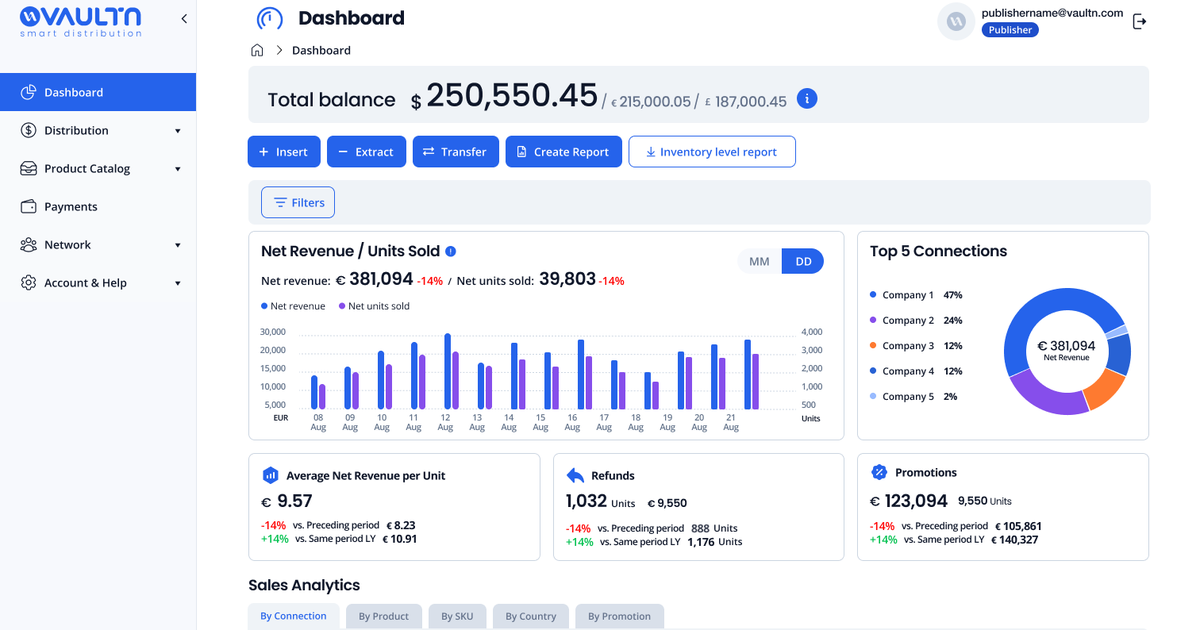
This data is available on a curated dashboard, allowing publishers to track partners, sales, and key insights.
“This lets them understand what works and which promotions perform well across different retail channels. The idea is for the VaultN platform to automate all the manual work involved and then provide valuable data insights that partners can act on.”
“Previously, these processes were manual and not scalable. Publishers typically worked with only a few major partners in core markets, making it challenging to access emerging markets.”
“We decided to build a platform that is unbiased and not aligned with anyone but provides a toolkit. We created something where every publisher can choose how to use it, whom to connect with, and set their own terms. We enable that. It’s infrastructure that can help solve this.”

Although VaultN is a B2B platform, Migura believes it will simplify key distribution for various stores, fostering greater diversity in the distribution ecosystem.
“We’ll reach more players because we can reach those who may not go to the main stores you could handle initially. We see this in some markets due to restrictions. In others, the units distributed through our channels exceed those of the platforms themselves. We’re helping users find their games better and picking up those users in the right places.”
“The idea is to give the toolkits to the industry to stop it from working against itself, and to work together”
“I think there’s a change where even in the narrower sense of the meaning of distribution, it’s no longer about just moving keys from A to B. It’s about really connecting ecosystems together and ultimately reaching players where they feel comfortable making a purchase decision and where they feel able to receive new products or be exposed to new products.
“The idea is to give the toolkits to the industry to stop it from working against itself, and to work together. For us, the solution was not to, hey, let’s build another platform, but that there are great platforms and channels out there, and we need to essentially enable better cooperation across those.”
