



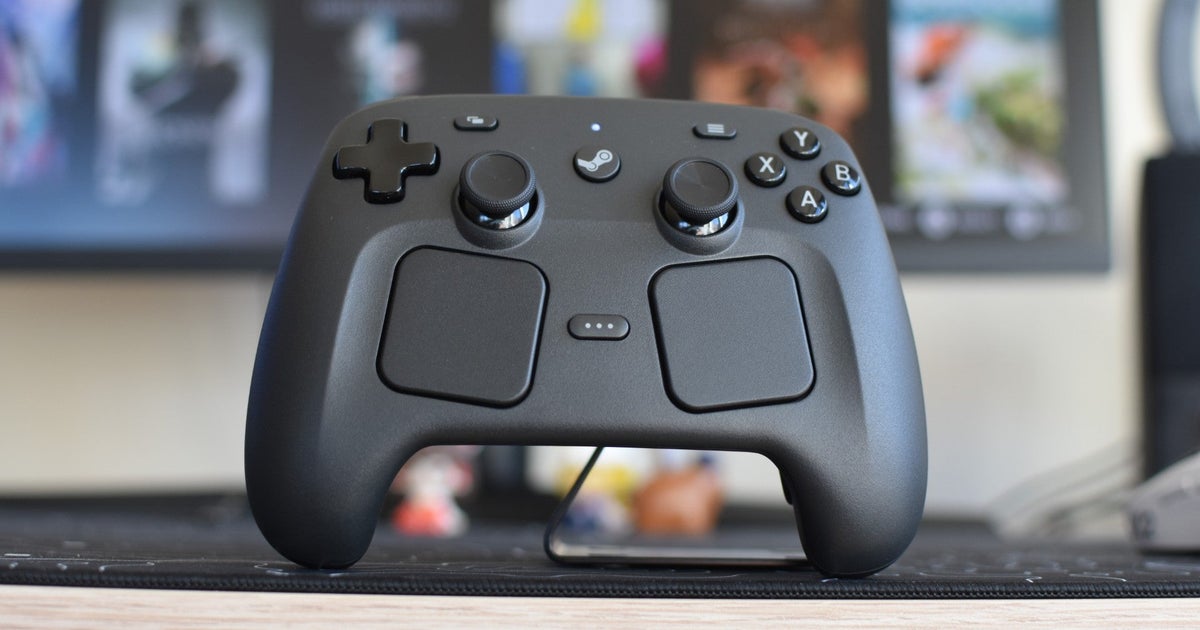
2026 is meant to be a key year for Valve’s ambitions in the hardware space, and next week, the first piece of the puzzle falls into place. Reviews for the Steam Controller – the compan’s redesigned gamepad, a decade on from the original’s troubled debut – are in, and they’re good. Remarkably good, in fact: a chorus of near-universal praise from outlets that you might expect to pick apart the idiosyncrasies of a $99 controller with far more relish.
It’s a great reception and should ensure a solid first launch in a year also set to include a home console and a standalone VR headset. It’s nonetheless fair to say that the Controller is the easiest part of what Valve has planned. The Steam Machine and the Steam Frame VR headset both have supply-chain related question marks floating around them, their launches slipping from “early 2026” to “first half of 2026” to a vaguer “this year” thanks to the memory and storage component crisis.
The Controller’s warm reception still feels significant. It speaks to how much anticipation has built around Valve’s hardware ambitions. What was once most charitably described as a side hobby for the company has reached a point where it’s arguably the most interesting thing in the gaming hardware space, even if Valve has yet to launch a product that really breaks into the mainstream.
So how did a company whose primary business is selling other people’s games quietly become one of the most interesting hardware makers in the industry? I’d argue that there are two complementary answers to that question.
The first is that Valve has spent decades building a relationship of remarkable trust with Steam customers. It’s become a meme that Valve repeatedly manages to “win” simply by continuing with a relatively traditional, straightforward approach to its business while its rivals shoot themselves in the foot with trend-chasing and hare-brained schemes. Steam is far from perfect, but from a consumer perspective it’s been an incredibly reliable and steady part of the gaming landscape for around twenty years, so much so that many millions of gamers implicitly trust the platform to be a safe repository for dozens if not hundreds of their games.
The second answer lies in iteration – a willingness to treat each of the company’s attempts at hardware not as a commercial moonshot, but as infrastructure for the future. Valve’s transformation into a seriously good hardware company happened largely under the radar because its key devices – the Steam Deck and, before it, the Valve Index – were modest performers commercially, even if they were very much celebrated by their owners. The Steam Deck in particular is a phenomenon among enthusiast PC gamers, but its total sales are somewhere in the single-digit millions: impressive for a handheld PC, but a rounding error compared to something like the Nintendo Switch.
Yet even if the Steam Deck has never caused a single wink of sleep to be lost in Kyoto, the positive reaction to it cemented the idea that Valve is pretty damned good at hardware – and the device itself has been instrumental in building the foundations for what comes next. The new Steam Controller is a clear example: it is, essentially, the Steam Deck’s control scheme liberated from the handheld itself. Valve designed it to contain every input option found on the Deck, which means that the thousands of games that already have well-implemented support for the Deck’s various control options carry that support over to the new controller without developers having to lift a finger. New controllers with unusual layouts or features turn up all the time on PC, but sink without a trace due to lack of software support; Steam Controller launches with its ecosystem already thoroughly populated.
The debt the Steam Machine owes to its predecessor runs even deeper. When Valve first attempted to do something like this in 2015, the project fizzled out due to two major problems – a fragmented hardware ecosystem farmed out to OEM partners, and a Linux OS that supported only a fraction of Steam’s library. In the decade since, Valve has been methodically solving both of those.
It’s taken control of its own hardware manufacturing, but even more impressive is Proton – the compatibility layer that allows the Linux-based SteamOS to run almost all Windows games without a hitch, and even in many cases with markedly better performance than on Windows itself. That software plays a major part in the positive perception of the Steam Deck, and it ensures that the Steam Machine, once it launches, will immediately plug in to a software infrastructure Valve has spent years refining.
Valve’s approach to hardware is cumulative, such that each device is both a product and a research programme
Among these devices, the Steam Frame is arguably attracting the least interest – perhaps because we’re just going through a significant lull in VR interest right now – but it follows the same logic. It departs substantially from the Valve Index – a well-respected PC-tethered headset that remained firmly in the enthusiast niche – in favour of a wireless design positioned against standalone headsets like the Meta Quest 3. The experience of building the Index clearly informs it, nonetheless. Valve’s approach to hardware is cumulative, such that each device is both a product and a research programme.
There’s little doubt that these products, when the global supply chain situation resolves itself to the point that they can finally launch, will be very solid and well-liked by their core target audiences. The harder question; can any of this translate into genuine mass-market impact?
“Well-respected niche product” and “mainstream hit” are very different outcomes, and Valve’s track record so far sits firmly in the former category. The Steam Controller, launched into a market where Sony’s DualSense costs $75 and Microsoft’s standard Xbox pad $65, is asking consumers to pay $99 for something that looks unusual and requires some explanation. The reviews suggest it fully deserves that premium – the use of TMR thumbsticks alone places the device ahead of even Sony and Microsoft’s premium Dualsense Edge and Xbox Elite controllers, which command even higher price points – but premium PC peripherals have often earned praise from reviewers while quietly underperforming at retail. There’s quite a commercial gulf between becoming a fixture for mainstream Steam users versus being the controller of choice for a dedicated cohort of power users and strategy game devotees.
The Steam Machine is arguably Valve’s best shot at a truly mainstream hardware product, but it comes with complications
The Steam Machine is arguably Valve’s best shot at a truly mainstream hardware product, but it comes with complications. Valve seems adamant that it won’t subsidise the device – it will be priced as a PC, not a console. Given the memory and storage shortages that have already forced multiple delays, that could put it uncomfortably above the price point of competing devices like the PS5. That may be a hard sell to a mass-market consumer who still thinks of Steam as something that lives on their existing PC, and it would invite significant scrutiny of the performance of the device. Questions have already been asked about whether its 8GB of VRAM might be limiting on AAA titles, for example, and the grace extended to the Steam Deck when its performance lags on major triple-A games may not be offered to a console hooked up to a 4K TV that sells in the same price range as a PS5 or even a PS5 Pro.
None of that necessarily spells failure – and it’s worth emphasising that “failure” for Valve is defined very differently to any other company in this market. A commercial outcome that would be catastrophic for Sony or Nintendo represents something far less drastic for a company whose core business is a digital storefront that controls around 75% of PC game distribution. Even if Steam Deck owners number only a few million, or if the Steam Controller sells primarily to enthusiasts, it represents additional spend on the platform from some of its most loyal customers – and people who didn’t buy Steam Decks or Steam Controllers continue buying games on Steam just the same. Valve can afford, in a way no traditional platform holder can, to have its hardware be beloved without being dominant.
These hardware products are no longer a side interest; they are growth vectors for a company that has already won the market it operates in
I would not, however, assume that Valve being comfortable with niche outcomes means they lack ambition. These hardware products are no longer a side interest; they are growth vectors for a company that faces the rather luxurious challenge of having already won the market it operates in. Steam’s dominance of PC game distribution leaves limited room for further software-side growth, and while the company’s private status means it doesn’t have to constantly chase quarterly growth (also a major factor in its aforementioned high-trust relationship with its consumers), the desire to see the lines go up is still undoubtedly present.
Hardware opens up markets Valve doesn’t currently reach: the Steam Deck pitches to potential Switch buyers, the Steam Machine to potential PS5 buyers, the Steam Frame to potential Meta Quest customers. Each device is trying to funnel a different kind of non-PC gamer into the Steam ecosystem.
Whether any of those recruitment drives will work at scale is the open question. What isn’t in doubt is that Valve has built something impressive – a real hardware operation that iterates thoughtfully and releases things that earn respect, even if they don’t make huge commercial waves.
What comes next – when the Steam Machine eventually arrives, when the Frame eventually ships, when Valve’s hardware ecosystem finally assembles itself into the coherent whole that the company envisions – will be more complicated, and the commercial stakes will be higher. For now, a set of glowing reviews and a sense of genuine excitement around its Controller launch is as promising a start as Valve could have hoped for. The puzzle has a long way to go – but the first piece fits.
